
The night sky may be heading toward a very strange future.
Not because of aliens. Not because Betelgeuse is about to explode for the 900th time according to someone’s Facebook uncle. This time, the problem is much closer to home: satellites.
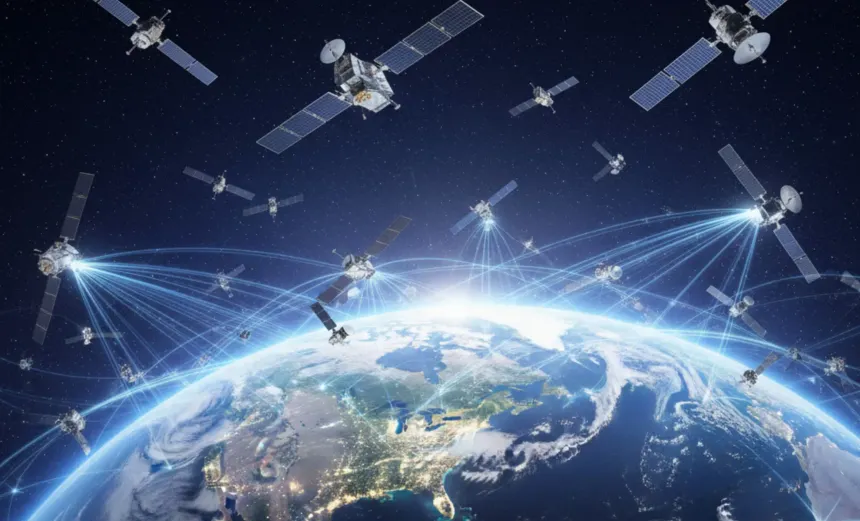
A new study highlighted by the European Southern Observatory warns that current proposals to launch more than 1.7 million satellites into orbit could have severe consequences for astronomy. ESO published the warning on 1 July 2026, describing the situation as going “beyond the limit” of what modern astronomy can withstand.
That is not a small number of satellites. That is not even a “busy sky.” That is humanity potentially turning low Earth orbit into the M25, except the traffic reflects sunlight and photobombs galaxies.
The Problem Is Bigger Than Bright Streaks
When people think about satellites ruining astronomy, they usually imagine a long bright trail cutting across a telescope image.
That is part of the problem, but it is not the whole problem.
According to ESO, the new study is the first to calculate how large and bright satellite constellations could increase the overall brightness of the night sky itself. That matters because astronomy depends on darkness. The fainter the object, the more vulnerable it is to background light. Distant galaxies, faint asteroids, and small planets around other stars can all become harder to detect if the sky is brighter.
So this is not just about one annoying streak across a pretty photo.
It is about raising the glow of the entire sky.
More Than 14,000 Satellites Are Already Up There
ESO says the number of satellites orbiting Earth has grown rapidly since 2019, reaching more than 14,000 today. Much of that growth has been driven by satellite internet constellations, especially SpaceX’s Starlink network.
But the concern is not only what is already in orbit.
It is what has been proposed.
ESO’s report points to several planned constellations that could add hundreds of thousands — or even more than a million — satellites to orbit. SpaceX has filed proposals involving up to one million additional satellites for space-based data centres, while other projects could add even more objects to the sky.
The study also mentions a company called Reflect Orbital, which has proposed mirror-like satellites that could reflect sunlight down to Earth at night. ESO says the company aims to begin with a prototype and eventually expand to 50,000 satellites by 2035.
That is where this stops sounding like normal satellite internet and starts sounding like someone modded the night sky without asking the rest of the lobby.
Mirror Satellites Could Be Extremely Bright
The most alarming part of the ESO article is the warning about mirror-like satellites.
Reflect Orbital’s proposed spacecraft would be designed to reflect sunlight toward Earth at night. ESO says their reflected beams would span at least five kilometres across Earth’s surface. If the full constellation were deployed, the study estimates that the night sky could contain hundreds of very bright visible satellites.
ESO reports that, from inside one of these reflected beams, a satellite could appear four times brighter than the full Moon. Even if the beam is not pointed directly at an observer, each mirror satellite could still appear as bright as Venus, one of the brightest natural objects in the night sky.
That is not a tiny dot quietly passing overhead.
That is a man-made object bright enough to dominate the sky.
Why Astronomers Are Worried
Modern observatories are built in remote, dark places for a reason.
ESO’s Very Large Telescope in Chile, for example, sits under some of the clearest skies on Earth. Observatories like this are designed to collect incredibly faint light from the universe. Some of that light has travelled for billions of years before reaching Earth.
A satellite streak can erase part of an image. A brighter sky can make faint objects harder to detect in the first place.
ESO says simulations found that a large SpaceX constellation could create dozens of trails in each image taken with the Very Large Telescope two hours into the night, causing field-of-view losses of up to 28%, assuming the satellites were faint enough not to be visible to the naked eye.
Other instruments could be hit even harder. ESO notes that a camera like the one on the Vera C. Rubin Observatory could have most of its images rendered unusable for several hours each night if satellites are too bright.
That is a big deal because Rubin is designed to scan the sky repeatedly, detecting changing objects such as supernovae, asteroids, and other time-sensitive events. If too many images are contaminated, we do not just lose pretty pictures. We lose data.
The Sky Itself Could Become Brighter
There is another problem: even satellites too faint to see directly can still add diffuse light to the sky.
ESO explains that faint satellites can create a general veil of light, while brighter satellites scatter light through Earth’s atmosphere. Both effects increase the background brightness of the night sky.
That matters because faint astronomical objects are already difficult to observe. The universe is full of things that are barely visible even with huge telescopes: distant galaxies, small near-Earth asteroids, dim stars, and possible Earth-like exoplanets around other stars.
If the sky gets brighter, those targets become harder to study.
The study warns that very bright constellations, especially mirror satellites, could have a major effect on sky brightness. With a full fleet of 50,000 Reflect Orbital satellites, ESO says the sky could become three to four times brighter overall.
That is not “a minor inconvenience.”
That is changing the natural darkness of the sky.
ESO Says There Needs to Be a Limit
The study argues that astronomy can only be protected if the number of satellites is limited.
ESO says no more than 100,000 faint satellites, below naked-eye visibility, should orbit Earth if we want to safeguard modern astronomical observations. The lead author, Olivier Hainaut, also says this is not a magic number where 99,999 is fine and 100,001 is disaster. It is more of an upper boundary where the losses become comparable to other technical problems, such as equipment failure.
The key point is that the satellites must also be faint.
If many satellites are bright enough to be seen by eye, the safe number would need to be much lower.
That is the brutal bit. The issue is not only how many satellites exist. It is how bright they are, where they orbit, how often they cross telescope fields, and how much light they add to the sky.
This Is Not Anti-Technology
Satellite internet can be useful. Global communications matter. Remote regions can benefit from better connectivity. Space technology is not automatically bad.
But there is a difference between using space responsibly and filling orbit with so many reflective objects that astronomy becomes collateral damage.
The night sky is not empty real estate. It is a shared scientific, cultural, and natural resource. Every generation before us had access to a dark sky. It would be a bit embarrassing if our generation is the one that looked up and said, “What if we monetised the stars?”
ESO says the FCC received more than 1,800 comments about Reflect Orbital and nearly 1,500 comments about SpaceX’s application. ESO, the UK’s Royal Astronomical Society, and the International Astronomical Union have also responded to the proposals.
So this is not just theoretical. Regulators are now part of the story.
Why This Matters
Astronomy is not only about curiosity. It helps us understand the universe, track potentially dangerous asteroids, study planets around other stars, and investigate the history of galaxies.
If the sky becomes brighter and more crowded with satellite trails, future discoveries may become harder, slower, or in some cases impossible from the ground.
That would be a strange trade: better internet coverage in exchange for making the universe harder to see.
The irony is brutal. We are building more technology in space while making it harder to study space.