
Some galaxies look peaceful from far away. Centaurus A is not one of them.
NASA has released a new image from the James Webb Space Telescope, showing the nearby galaxy Centaurus A in extraordinary infrared detail. The image was published on 6 July 2026 to mark Webb’s fourth year of science operations, and it reveals a galaxy that is not just beautiful, but deeply disturbed.
Centaurus A is about 11 million light-years from Earth, which makes it relatively close by cosmic standards. But what makes it especially interesting is not just its distance. It is the fact that this galaxy is still showing the scars of a violent collision with another galaxy roughly two billion years ago.
That ancient impact twisted its structure, stirred up dust, triggered star formation, and helped create one of the strangest nearby galaxies we can study. In other words, Centaurus A is what happens when a galaxy survives a crash and refuses to act normal afterwards.
Webb Looked Through the Dust
Centaurus A has been observed before, including by the Hubble Space Telescope and the retired Spitzer Space Telescope. But Webb brings something different.
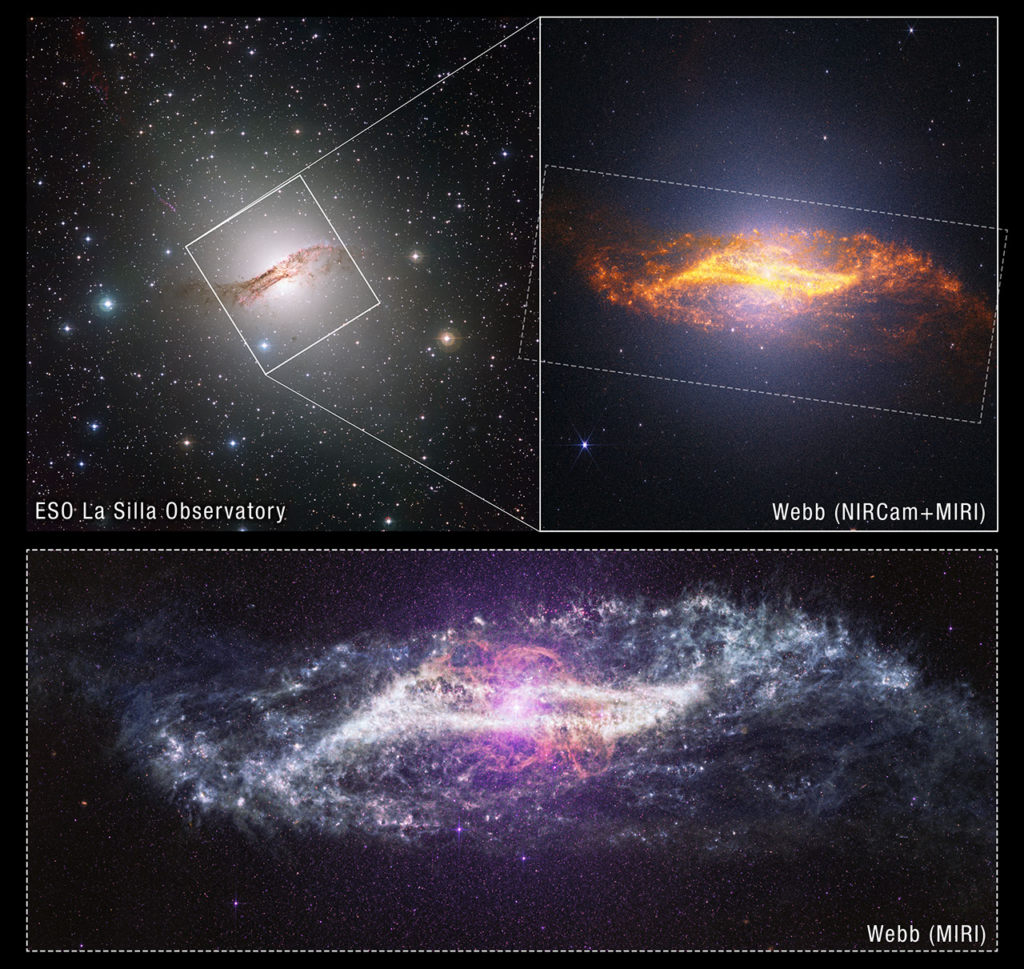
Hubble sees mostly visible light, which can be blocked by thick dust. Spitzer could see in infrared, but with less detail. Webb combines powerful infrared sensitivity with extremely sharp resolution, allowing astronomers to see through dusty regions and reveal structures that were previously hidden.
That matters because Centaurus A has a huge dust lane cutting across its centre. In visible-light images, this dust lane looks like a dark band slicing through the bright galaxy. It makes the galaxy look dramatic, but it also hides much of what is happening inside.
Webb’s infrared view changes that. Instead of just seeing the blocked light, Webb reveals the dust itself glowing in complex shapes. NASA says the new view shows dusty structures, hidden activity, and a densely packed field of individual stars inside the galaxy’s long-obscured central region. So this is not just a sharper image. It is a deeper look into a galaxy’s wreckage.
A Galaxy With a Feeding Black Hole
At the centre of Centaurus A sits a supermassive black hole that is actively feeding on surrounding material. As matter falls toward the black hole, the system releases enormous energy and launches powerful jets that help shape the galaxy around it.
This is one of the reasons Centaurus A is classed as an active galaxy. A normal galaxy can contain a quiet central black hole. Centaurus A is different. Its black hole is not just sitting there like a cosmic decoration. It is interacting with the surrounding gas and dust, influencing the galaxy’s behaviour.
That is what makes this object scientifically useful. Centaurus A gives astronomers a nearby example of something much bigger: how black holes and galaxies grow together. We often think of black holes as things that simply eat matter. But in galaxies, they can also shape their environment. Their jets and outflows can heat gas, push material around, and either encourage or suppress star formation. Very polite behaviour from an object famous for not letting light escape.
Webb Found a Strange S-Shaped Feature
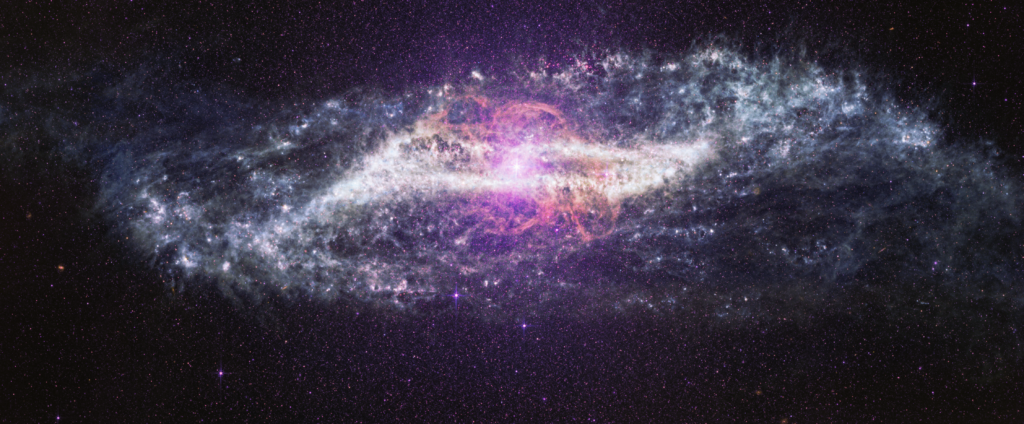
One of the most eye-catching details in Webb’s new view is an unusual S-shaped structure visible in the mid-infrared image taken by Webb’s MIRI instrument.
NASA says this feature is especially noticeable in the MIRI view and raises new questions. Scientists do not yet know exactly what created it. It could be connected to the galaxy’s central black hole, star formation triggered by the ancient merger, or other activity inside the galaxy. That uncertainty is what makes the image more interesting.
A lot of space images are presented as if the universe has been neatly solved. This one is the opposite. Webb has revealed more detail, but that detail has opened new questions. What formed the S-shaped structure? How much is the black hole shaping it? How much of it comes from the old galaxy collision? How much is linked to new stars being born from disturbed gas and dust?
The image does not just answer questions. It creates better ones.
Millions of Stars, One Galactic Timeline
In Webb’s combined near-infrared and mid-infrared view, parts of Centaurus A look almost grainy. But NASA explains that this grainy appearance is not image noise. It is a densely packed field of individual stars.
Different groups of stars can tell astronomers when bursts of star formation happened, when the galaxy was calmer, and when the collision stirred up enough gas to create new stars. NASA describes this as a form of galactic archaeology. By studying the stars revealed by Webb, astronomers can reconstruct parts of Centaurus A’s past: when older stars formed, when star formation slowed, when the collision caused new activity, and how the galaxy changed after the merger.
That is the real power of this image. It is not just showing what Centaurus A looks like now. It is helping scientists read the timeline of a galaxy that was smashed, reshaped, and reactivated over billions of years.
Dust Is Not Just Something in the Way
In astronomy, dust often sounds like a nuisance. It blocks visible light. It hides stars. It makes galaxies harder to study. Very rude, honestly. But dust is also one of the most important ingredients in the universe.
NASA notes that many of the glowing red points in Webb’s mid-infrared image may be dust-rich stars or stellar nurseries, where aging stars are shedding material back into space or new stars are forming. That dust becomes raw material for future generations of stars and planets.
That means Webb is not just showing old wreckage. It is showing recycling on a galactic scale. Stars are born, live, shed material, die, and seed the galaxy with ingredients that can eventually become new stars, planets, moons, and possibly the chemistry needed for life. Centaurus A may be scarred by a collision, but it is not dead. It is still changing.
The Black Hole May Both Create and Destroy
One of the biggest questions in astronomy is how supermassive black holes affect their host galaxies. Centaurus A is useful because it is close enough for Webb to study in great detail, but active enough to show powerful black hole behaviour.
NASA says early findings from Webb show fast-moving ionized gas flowing outward, likely driven by the black hole’s activity, along with warmer molecular hydrogen in a warped rotating disk near the centre. These observations help scientists study how a black hole can influence an entire galaxy.
The answer is not simple.
A black hole can help trigger star formation by compressing gas. But it can also limit star formation by pushing material away. In other words, the same black hole can act like both a starter motor and a cosmic leaf blower. That is why galaxies like Centaurus A matter. They show that black holes are not isolated monsters at the centre of galaxies. They are part of the galaxy’s evolution.
Centaurus A is one of the best nearby laboratories for studying the connection between galaxy collisions, star formation, dust, and black hole activity. Webb’s new image reveals structures that visible-light telescopes could not properly see. It also resolves millions of stars, traces dust in never-before-seen detail, and helps astronomers study gas moving near a supermassive black hole. That combination gives scientists a more complete view of how galaxies evolve after a major collision.
Centaurus A gives us a nearby example of what a post-collision galaxy can look like long after the crash. Not instantly destroyed. Not neatly repaired. Still active. Still distorted. Still forming stars. Still shaped by the black hole at its heart.