Black holes are often described as cosmic monsters.
They swallow stars, bend light, distort time, and sit in space like invisible traps where gravity has gone completely feral. But one question always seems to stand above the rest.
What would actually happen if you fell into one?
Would you be crushed instantly? Would you see the entire future of the universe flash before your eyes? Would you pass into another dimension, another universe, or simply become the universe’s least recoverable smoothie?
The honest answer is both terrifying and fascinating.
Falling into a black hole would not be like falling into a normal object. There is no solid surface waiting for you at the edge. You would not hit a wall. You would not splash into some cosmic ocean. Instead, you would cross a boundary where escape becomes impossible, where time behaves strangely, and where gravity pulls so unevenly that your body would eventually be stretched apart.
That process has a famous and slightly ridiculous name.
Spaghettification.
Yes, one of the most horrifying deaths in astrophysics sounds like something ordered at an Italian restaurant by mistake.
But before we get there, we need to understand what a black hole actually is.
What Is a Black Hole?
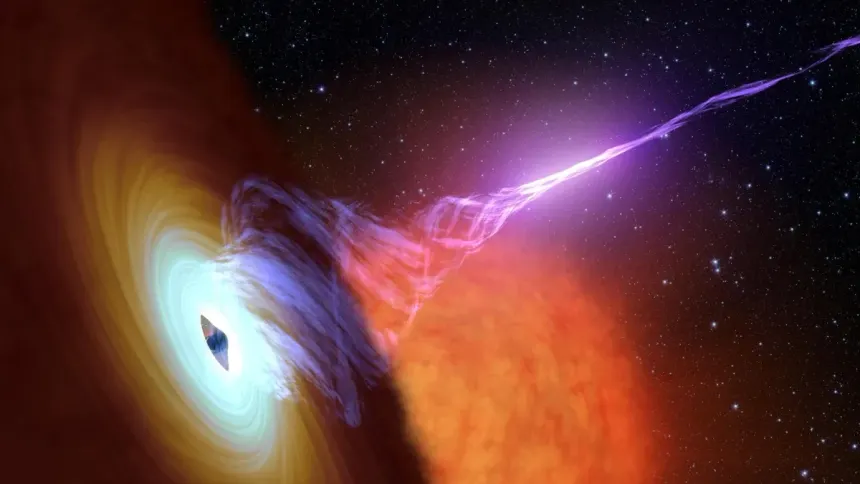
A black hole is a region of space where gravity is so strong that nothing can escape once it gets too close. Not planets. Not stars. Not gas. Not even light.
That last part is what makes black holes black.
We see objects because light reflects off them or comes from them. But if light itself cannot escape a black hole, then the black hole becomes invisible against space. We cannot see the black hole directly. Instead, we detect it by watching what it does to everything around it.
Gas can heat up as it spirals around a black hole. Stars can orbit something invisible. Light from distant objects can bend around it. In other words, black holes reveal themselves through chaos.
The boundary around a black hole is called the event horizon. This is the point of no return. Cross it, and every possible path through space leads inward.
That does not mean you instantly die the moment you cross it. The event horizon is not a physical surface. If the black hole is large enough, you might pass through without noticing anything dramatic at first.
Which is somehow even creepier.
What Happens As You Approach?
As you move closer to a black hole, gravity grows stronger. But the real problem is not just the strength of gravity. It is the difference in gravity between one part of your body and another.
If you fell feet first, your feet would be closer to the black hole than your head. That means your feet would feel a stronger gravitational pull than your head. The closer you got, the more extreme that difference would become.
This is called tidal force.
On Earth, tidal forces from the Moon help create ocean tides. Around a black hole, tidal forces can stretch entire stars apart. So yes, your body would have a bad day. A very bad day. A strongly worded complaint to physics would not help.
Eventually, the pull on your feet would become so much stronger than the pull on your head that your body would stretch. At the same time, you would be squeezed from the sides.
This is spaghettification.
It is not science fiction. It is a real consequence of gravity acting unevenly across an object. The stronger and more concentrated the gravity, the worse the effect becomes.
Would You Die Before Reaching the Event Horizon?
That depends on the size of the black hole.
For a small stellar mass black hole, the tidal forces near the event horizon would be enormous. You would likely be stretched apart before you even crossed the boundary.
For a supermassive black hole, the situation is stranger.
Supermassive black holes can contain millions or billions of times the mass of the Sun. Because their event horizons are much larger, the tidal forces at the edge can be surprisingly gentle compared with smaller black holes.
That means you could, in theory, cross the event horizon of a supermassive black hole without immediately feeling anything unusual.
No alarm. No glowing doorway. No dramatic space thunder.
Just one quiet step across an invisible boundary.
And after that, the universe has locked the exit.
What Would Someone Else See?
This is where black holes become properly weird.
To you, falling in, time would feel normal. Your watch would tick as usual. Your thoughts would continue as usual. You would not personally feel time slowing down.
But to someone watching from far away, things would look very different.
As you approached the event horizon, your light would become stretched and dimmer. You would appear to slow down. From their point of view, you would never quite seem to cross the event horizon. Instead, you would fade, freeze, and gradually disappear.
This is not because you actually stop moving. It is because gravity affects light and time. Near a black hole, time runs differently compared with far away space.
So from your perspective, you fall in.
From the outside observer’s perspective, you appear to slow down forever.
Black holes are basically the universe saying, “same event, different receipts.”
Would You See the Future of the Universe?
A popular idea says that if you fell into a black hole, you might see the entire future of the universe speed up around you.
There is a grain of truth hiding inside that idea, but it is often exaggerated.
Because of gravitational time dilation, time far away from the black hole can appear to pass faster compared with your own time near the event horizon. So in principle, you might see outside events sped up.
But reality is messier. Light would be distorted, shifted, and eventually limited by the direction you are falling. You would not get a clean cinema style montage of the universe’s future. There would be no comfortable front row seat, no popcorn, and sadly no refund.
Instead, you would experience extreme visual distortion as light bends around the black hole. The universe could appear warped, squeezed, and strangely bright in some directions.
Then, once you cross the event horizon, signals from outside can still enter, but you can never send anything back out.
You can receive the universe.
The universe cannot receive you.
Which is a dramatic way of saying your final text message is not going through.
What Is Inside a Black Hole?
This is one of the biggest unknowns in modern physics.
According to general relativity, everything inside a black hole falls toward the singularity. A singularity is often described as a point of infinite density where the known laws of physics break down.
But “infinite density” is usually a sign that our theory has reached its limit.
Most physicists do not think we fully understand what happens at the very center of a black hole. General relativity explains gravity on large scales extremely well. Quantum mechanics explains tiny particles extremely well. But inside a black hole, both worlds collide.
We need a theory of quantum gravity to properly describe what is happening there.
That is why black holes are so important. They are not just cosmic vacuum cleaners. They are laboratories for the most extreme physics in the universe.
The problem is that the laboratory has no windows, destroys the equipment, and refuses to return the interns.
Could a Black Hole Lead Somewhere Else?
This is where science meets speculation.
Some theories suggest that black holes could be connected to wormholes, white holes, or other regions of spacetime. These ideas are mathematically interesting, and they appear in serious discussions of general relativity.
But there is no evidence that real black holes are usable portals.
In science fiction, a black hole might be a doorway. In real astrophysics, it is more likely a one way gravitational disaster.
Even if wormholes could exist, they would probably be unstable without exotic forms of matter or energy that we have never observed in the required way. So while it is fun to imagine black holes as cosmic tunnels, we should not treat that as the likely outcome.
If you fall into a black hole, the safe bet is not “interstellar shortcut.”
The safe bet is “you are now part of the problem.”
Why Black Holes Matter
Black holes are not just terrifying. They are also essential to our understanding of the universe.
Supermassive black holes sit at the centres of many galaxies, including our own Milky Way. Their gravity influences stars, gas, and the evolution of galaxies over billions of years.
Black holes also help scientists test the limits of physics. They challenge our understanding of gravity, time, information, and quantum mechanics.
One of the biggest mysteries is the black hole information paradox. If information falls into a black hole, is it destroyed forever? Quantum mechanics says information should not be destroyed. Black holes seem to suggest otherwise.
This is not just a tiny technical issue. It is one of the deepest problems in modern physics.
Black holes force scientists to ask whether our current understanding of reality is incomplete.
And usually, when the universe forces that kind of question, things get interesting.
So, What Would Really Happen?
If you fell into a black hole, your experience would depend on the black hole’s size.
Near a smaller black hole, tidal forces would tear you apart before you reached the event horizon.
Near a supermassive black hole, you might cross the event horizon without noticing anything dramatic at first. But once inside, escape would be impossible. Every path would lead deeper inward. Eventually, tidal forces would become extreme, and your matter would be stretched, compressed, and pulled toward whatever lies at the centre.
From the outside, you would appear to slow down and fade away.
From your perspective, you would continue falling.
And beyond the event horizon, no one outside could ever receive your final report.
That is what makes black holes so fascinating. They are not just objects in space. They are places where our normal ideas about time, gravity, and reality begin to fall apart.
A black hole is not simply a thing that destroys matter.
It is a question mark carved into the universe.
And the closer we look, the stranger that question becomes.