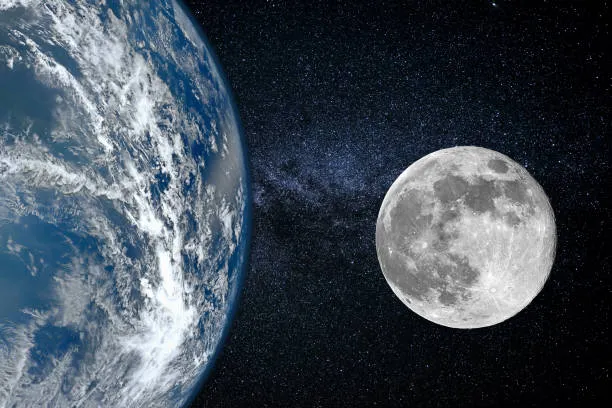

The Moon looks like it has always been there.
Every night, it rises above Earth like a familiar old companion. It controls the tides, lights up the night sky, appears in eclipses, and has shaped human mythology, calendars, science, and exploration for thousands of years.
But here is the strange part. The Moon is not staying still. It is slowly moving away from Earth.
Not fast enough to notice by looking up at the sky. Not fast enough to ruin your evening walk. But year after year, century after century, the Moon is drifting farther away from us.
Scientists have measured this movement very precisely. On average, the Moon is moving away from Earth by about 3.8 centimetres per year.
That may sound tiny. It is about the rate your fingernails grow. But across millions and billions of years, tiny movements become enormous changes.
So why is the Moon moving away from Earth?
And what does that mean for the future of our planet?
The answer involves tides, gravity, Earth’s rotation, Apollo mirrors, and a cosmic relationship that is slowly changing right above our heads.
The Moon Is Not Escaping Earth
First, let’s clear up one common misunderstanding.
The Moon moving away from Earth does not mean it is about to fly off into space tomorrow. The Moon is still gravitationally bound to our planet. It still orbits Earth, and Earth still holds it firmly in place. This is not a dramatic breakup. It is more like a very slow long-distance relationship.
The average distance between Earth and the Moon is about 384,400 kilometers. Compared with that, 3.8 centimeters per year is unbelievably small. If the Moon were a person slowly backing away from you at that speed, you would have enough time to make tea, raise a family, build a civilization, forget why you were worried, and still barely notice the movement.
But astronomically, the movement matters.
Over billions of years, the Moon has moved a huge distance from where it once was. Early in Earth’s history, the Moon was much closer. It would have appeared much larger in the sky, and its gravitational effect on Earth’s tides would have been far stronger. The Moon we see today is not the Moon our ancient planet saw.
https://spaceopedia.co.uk/how-far-is-the-moon-from-earth/: Why Is the Moon Moving Away From Earth?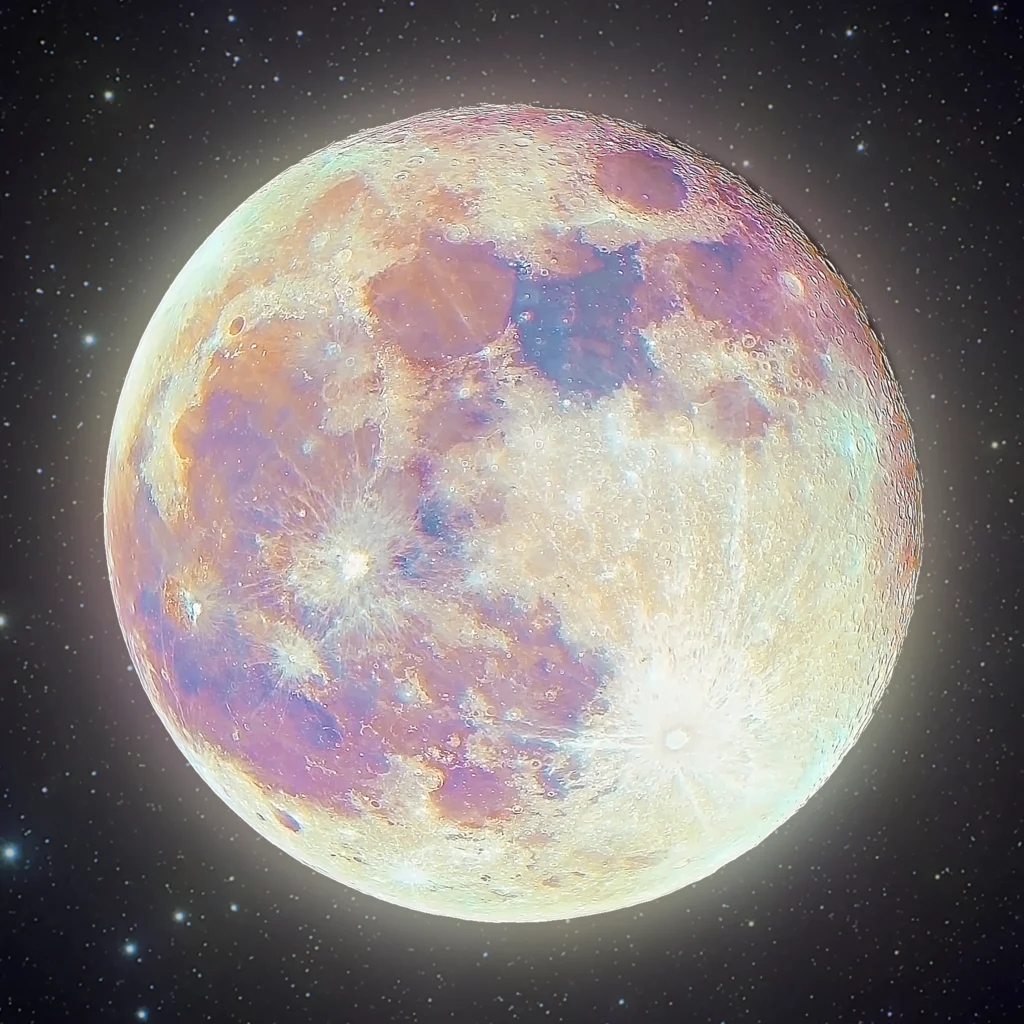
How Do We Know the Moon Is Moving Away?
This is not a guess. Scientists have actually measured it.
During the Apollo missions, astronauts placed special mirrors on the Moon’s surface. These are called retroreflectors. They reflect light back in the same direction it came from. Scientists on Earth can fire laser pulses at these reflectors. The light travels from Earth to the Moon, bounces off the reflector, and returns to Earth. By measuring how long that round trip takes, scientists can calculate the Moon’s distance with extraordinary precision.
Light travels extremely fast, but the Moon is far away, so the full round trip takes roughly 2.5 seconds. By repeating this measurement over many years, researchers discovered that the Moon’s average distance from Earth is increasing. That is how we know the Moon is slowly drifting away.
Not because someone looked up and thought, “Hmm, seems a bit further left today.”
Actual lasers. Actual mirrors. Actual physics. The Moon may be silent, but apparently it does answer when we ping it.
The Real Reason: Tides
The Moon is moving away because of tides. Most people think tides are just the ocean going in and out. But tides are really a result of gravity stretching Earth. The Moon’s gravity pulls on Earth. Because Earth is not a perfectly rigid object, that pull creates tidal bulges. The oceans respond most visibly, but the solid Earth also deforms slightly.
Here is the key part. Earth rotates faster than the Moon orbits.
Earth completes one rotation in about 24 hours. The Moon takes about 27.3 days to orbit Earth relative to the stars. Because Earth spins faster, the tidal bulge caused by the Moon gets carried slightly ahead of the Moon’s position.
That bulge has gravity too. So the tidal bulge pulls forward on the Moon, giving it a tiny boost in its orbit. When the Moon gains orbital energy, it moves into a slightly higher orbit.
That means it moves farther away. At the same time, Earth loses some rotational energy. This means Earth’s rotation is gradually slowing down. So the Moon is drifting away because Earth is effectively transferring some of its spin energy to the Moon’s orbit.
That is the simplest version.
Earth spins. The Moon raises tides. The tidal bulge gets pulled ahead. The bulge tugs the Moon forward. The Moon moves outward. Earth’s rotation slows.
It is not magic. It is gravity doing accounting.
And gravity always keeps the receipts.
Earth’s Days Are Getting Longer
If the Moon is taking energy from Earth’s rotation, then Earth’s spin must be slowing down. That means days on Earth are getting longer. Again, the effect is tiny on human timescales. You are not going to wake up next Thursday and find out the day is now 29 hours long, although, to be fair, many of us could use the extra sleep.
But over deep time, the effect becomes significant.
In Earth’s distant past, days were much shorter. Billions of years ago, Earth may have rotated much faster than it does today. As the Moon gradually moved away and tidal interactions slowed Earth’s rotation, the length of the day increased.
This means the Moon has not only shaped Earth’s tides. It has also influenced the rhythm of time on our planet. Every day you experience is part of a long gravitational story between Earth and the Moon. That is slightly dramatic, yes. But also true.
Was the Moon Always This Far Away?
No.
The Moon was once much closer to Earth. The leading explanation for the Moon’s origin is the giant impact hypothesis. According to this idea, early Earth was struck by a large planetary body, often called Theia. The impact blasted material into orbit around Earth, and that debris eventually came together to form the Moon.
This likely happened over 4 billion years ago, when the Solar System was young and frankly behaving like a cosmic demolition derby. After the Moon formed, it orbited much closer to Earth than it does now. Since then, tidal interactions have slowly pushed it outward. This means the Earth-Moon system has changed dramatically over time.
In the ancient past, the Moon would have looked much larger in the sky. Tides would have been stronger. Earth’s rotation would have been faster. The entire relationship between Earth and Moon would have felt more intense.
The Moon has not always been the calm, distant companion we see today. It was once much closer. And Earth was spinning faster beneath it.
Will the Moon Eventually Leave Earth?
This is the big question. If the Moon keeps moving away, will it eventually escape Earth completely?
The likely answer is no.
The Moon is moving away slowly, but this process will not continue forever in the same way. In theory, the Earth and Moon could eventually reach a state where Earth’s rotation and the Moon’s orbit become tidally locked to each other. That would mean Earth would rotate once for every lunar orbit, always showing the same side to the Moon, just as the Moon already shows the same side to Earth.
But the Sun complicates this.
Long before the Earth-Moon system reaches that final state, the Sun will evolve into a red giant. That future transformation will dramatically change the inner Solar System. Earth may become uninhabitable, severely altered, or possibly engulfed depending on how the Sun’s expansion and mass loss play out.
So while the Moon is moving away, it is not realistically expected to simply wander off into the galaxy while Earth waves sadly from below. The Sun will likely ruin the party first.
Classic Sun behaviour.
Does This Mean Total Solar Eclipses Will End?
Yes, eventually. One of the most amazing coincidences in our sky is that the Moon and Sun appear almost the same size from Earth. The Sun is about 400 times wider than the Moon, but it is also about 400 times farther away. Because of this, the Moon can perfectly cover the Sun during a total solar eclipse.
That is why we can see the Sun’s outer atmosphere, called the corona, during totality. But as the Moon moves farther away, it appears slightly smaller in the sky. Eventually, it will be too far away to fully cover the Sun.
When that happens, total solar eclipses will no longer occur on Earth. Instead, the Moon will only create annular eclipses, where a bright ring of sunlight remains visible around it. Do not panic. This will not happen soon.
Total solar eclipses should continue for hundreds of millions of years. But in the very distant future, Earth will lose one of its most spectacular natural events. So if you ever get the chance to see a total solar eclipse safely, take it. The universe is offering a limited-time feature.
Is the Moon Important for Life on Earth?
The Moon has probably played an important role in making Earth the planet we know.
Its gravity helps create tides, which may have influenced coastal environments and the evolution of life. Tides mix oceans, move nutrients, and shape shorelines. The Moon also helps stabilize Earth’s axial tilt.
Earth’s axis is tilted by about 23.5 degrees, which gives us seasons. Without the Moon, Earth’s tilt could vary much more dramatically over long periods. Large changes in tilt could cause extreme climate shifts.
That does not mean life would be impossible without the Moon. But Earth without the Moon would likely be a very different planet. The Moon is not just a pretty object in the sky.
It is part of Earth’s stability system. It affects our tides, our rotation, our climate patterns, and the long-term behavior of our planet. Not bad for a dusty rock everyone keeps calling dead.
Why Does the Moon Always Show the Same Face?
The Moon is already tidally locked to Earth. That means it rotates once on its axis in the same time it takes to orbit Earth. Because of this, the same side of the Moon always faces us.
This happened because Earth’s gravity caused tidal forces inside the Moon. Over time, those forces slowed the Moon’s rotation until it matched its orbital period. This is why we have a near side and a far side of the Moon.
The far side is not the “dark side” in the permanent sense. It receives sunlight just like the near side does. We simply cannot see it from Earth because the Moon’s rotation and orbit are synchronised.
Tidal locking is another example of how gravity changes worlds over time. The Moon’s rotation was altered by Earth. Now Earth’s rotation is slowly being altered by the Moon. The relationship goes both ways.
What Would Earth Look Like Without the Moon?
If the Moon suddenly disappeared, Earth would not instantly explode, despite what a very dramatic movie trailer might suggest. But things would change.
Tides would become much weaker, though the Sun would still produce some tides. Nights would be darker. Many animals that rely on moonlight or tidal cycles would be affected. Earth’s axial tilt could become less stable over long timescales.
The Moon also helps slow Earth’s rotation through tidal interactions. Without it, Earth’s long-term rotational history would have been different. In other words, the Moon is not just decoration. It is not some optional sky accessory.
It is deeply connected to Earth’s past and present. Our planet and its Moon are a system. And that system is still evolving.
The Moon Is Leaving, But Very Slowly
So yes, the Moon is moving away from Earth.
But no, it is not disappearing anytime soon.
It drifts away by about 3.8 centimetres per year because tidal interactions transfer energy from Earth’s rotation to the Moon’s orbit. This makes the Moon’s orbit grow slightly larger while Earth’s spin slowly decreases. It is a tiny movement each year, but across deep time it tells a much bigger story.
The Moon used to be closer. Earth used to spin faster. Days used to be shorter. Tides used to be stronger. And in the distant future, the Moon will appear smaller in our sky than it does today. That is what makes this so fascinating. The Moon feels permanent because human lives are short.
But on cosmic timescales, even the Moon is moving. The night sky is not frozen. It is changing. Slowly, quietly, and by just a few centimetres a year, the Moon is drifting away from us. And every time you look up at it, you are seeing a relationship that has been evolving for more than four billion years. Not a still image.
A slow-motion goodbye.