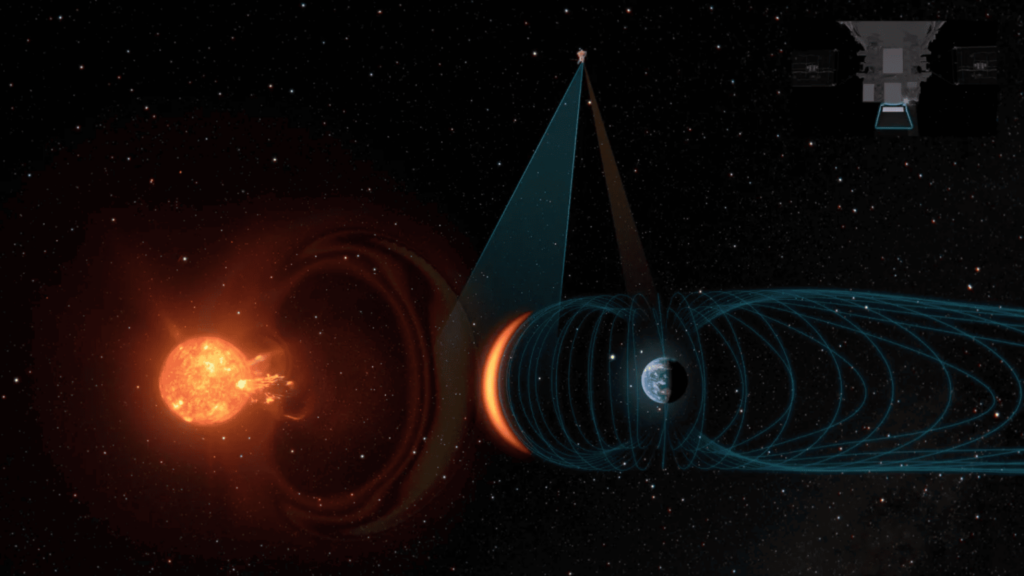

Earth is not just floating naked through space.
Thankfully.
Our planet is surrounded by an invisible protective bubble called the magnetosphere. It is created by Earth’s magnetic field and helps shield us from the solar wind — a constant stream of charged particles flowing from the Sun. Without it, Earth would be a very different place. Less “blue planet full of life,” more “crispy space pebble with commitment issues.”
Now, a new spacecraft is preparing to study that shield in a way no mission has done before.
ESA’s Smile mission has reached its designated science orbit after launching on 19 May 2026 aboard a European Vega-C rocket. ESA confirmed that Smile reached its science orbit on 20 June 2026, and the mission team is now commissioning the spacecraft’s science instruments before observations begin.
What Is the Smile Mission?
Smile stands for Solar wind Magnetosphere Ionosphere Link Explorer. It is a joint mission between the European Space Agency and the Chinese Academy of Sciences. Its job is to study how Earth responds when the Sun throws particles and radiation at our planet.
That might sound calm and academic, but the subject itself is anything but calm.
The Sun constantly releases the solar wind. During stronger solar activity, huge eruptions can disturb Earth’s magnetic environment, producing geomagnetic storms. These storms can create beautiful auroras, but they can also affect satellites, communications, navigation systems, power grids, and astronauts.
So Smile is not just studying a pretty light show. It is studying the system that helps protect modern civilisation from space weather.
Very comforting. Nothing says “relaxing afternoon” like remembering our entire technological society is sitting under an invisible magnetic umbrella.
Smile Will Watch Earth’s Shield in X-Rays
The most interesting part of Smile is how it will observe Earth.
ESA says the spacecraft will use an X-ray camera to make the world’s first X-ray observations of Earth’s magnetic shield. It will also use an ultraviolet camera to watch the northern lights for up to 45 hours at a time.
That combination matters.
The X-ray camera will help reveal where the solar wind hits Earth’s magnetosphere. The ultraviolet camera will watch the auroras that appear when disturbances travel down toward the polar regions. By comparing both views, scientists can track how energy moves from the Sun into Earth’s magnetic environment.
In simple terms, Smile will help scientists see the full chain reaction:
the Sun throws particles, Earth’s magnetic shield reacts, and the sky lights up near the poles.
It is basically Earth’s defence system being filmed in real time.
Why Earth Needs This Shield
Earth’s magnetosphere is one of the reasons our planet is habitable.
The solar wind is made of charged particles streaming outward from the Sun. Over long periods of time, that kind of particle attack can strip atmospheres and damage exposed surfaces. Earth’s magnetic field acts as a barrier, deflecting much of that material away from the planet.
That does not mean nothing gets through. During solar storms, Earth’s magnetic field can become disturbed. Those disturbances can trigger auroras, but they can also cause problems for spacecraft and technology.
The magnetosphere is not a solid wall. It bends, stretches, compresses, and ripples depending on what the Sun is doing. That is what makes it so difficult to understand.
Smile’s job is to watch those changes as they happen.
The Spacecraft’s Strange Orbit
Smile is not orbiting Earth like a normal satellite.
ESA says the spacecraft is now in a highly elliptical orbit. It travels as far as about 120,920 kilometres above the North Pole, where it will collect data on Earth’s magnetic bubble and auroras. Then it drops down to about 5,027 kilometres above the South Pole to send that data back to scientists.
That orbit is designed for long observations of the northern polar region.
It also explains why Smile can watch auroras for such long periods. Instead of quickly passing over the poles like many satellites, it spends extended time high above Earth, looking down at the region where solar storms create some of their most visible effects.
The mission reached that orbit after a series of engine burns. ESA says Smile fired its main engine 12 times after launch: 11 burns to raise its height above the North Pole, then one final burn to raise its height above the South Pole.
That is quite a lot of cosmic steering. Spacecraft do not simply “arrive” where they need to be. They usually get there through careful burns, calculations, and the kind of patience that would make most humans throw the controller across the room.
Smile Is in Excellent Condition
The good news is that the spacecraft appears to be doing well.
ESA reported that Smile is in excellent condition, and its engine performed better than expected. That saved extra propellant, which could increase the potential lifetime of the mission. Around 164 kilograms of propellant remains for orbit maintenance and science operations over the next three-plus years.
That matters because space missions often live and die by fuel margins.
More remaining propellant means more flexibility. It can help the spacecraft maintain its orbit for longer and continue collecting useful data. In spaceflight terms, “we saved fuel” is basically the engineering version of finding £20 in an old jacket.
When Will the Real Science Begin?
Smile has reached its science orbit, but it is not fully operational yet.
The spacecraft is now in its commissioning phase. That means the mission team is switching on, checking, and calibrating the instruments to make sure everything works properly. ESA says this commissioning campaign will last until the end of August 2026, with real science operations expected to begin in September 2026.
So this is the moment before the mission properly opens its eyes.
Once science begins, Smile should start giving researchers a new kind of view of Earth’s magnetic environment — not just local measurements from one point in space, but global images of how the magnetosphere reacts to the Sun.
That is the key difference.
Previous missions have measured parts of the magnetic environment. Smile is designed to show the bigger picture.
Why This Mission Matters
Space weather is not just an astronomy topic. It affects Earth.
Strong solar storms can interfere with satellites, GPS, radio communications, and electrical systems. As humanity depends more on satellites and plans longer human missions beyond Earth, understanding space weather becomes more important.
Smile could help improve models of Earth’s magnetic environment, which may help protect astronauts and space technology in the future. ESA says the mission will study solar storms, geomagnetic storms, and the science of space weather over the next three-plus years.
This is the part people often miss.
Earth is protected, but not perfectly protected. Our magnetic field is powerful, but the Sun is not exactly a calm neighbour. It is more like a nuclear furnace with mood swings.
Smile is going to watch how Earth handles those mood swings.