
We live inside the Milky Way, but that does not mean we have a perfect map of it.
In fact, that is one of the weirdest things about astronomy. We can study galaxies millions of light-years away, photograph distant nebulae, and detect planets around other stars, yet mapping our own galaxy is still painfully difficult. It is a bit like trying to draw your entire house while standing inside a cupboard.
Now, a new result from NASA’s Chandra X-ray Observatory, using data from ESA’s XMM-Newton, suggests that the outer spiral arms of the Milky Way may stretch farther out than scientists previously thought. The finding was published by NASA on July 1, 2026.
The Milky Way’s Map May Need Updating
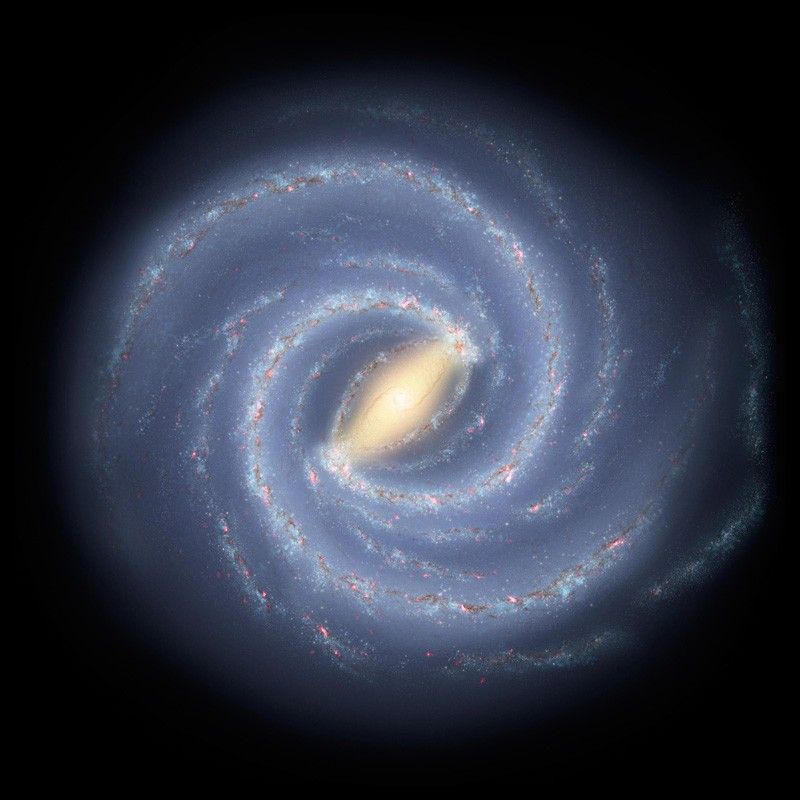
The Milky Way is a spiral galaxy, meaning it has long arms of stars, gas, and dust curling outward from its centre. Our Solar System sits inside one of these arms, which is exactly what makes the galaxy so hard to map.
If we could fly far above the Milky Way and look down, the job would be easy. Unfortunately, humanity has not yet unlocked the “zoom out of the galaxy” button. Very poor game design.
Instead, astronomers have to measure distances from inside the disk itself. That means looking through clouds of dust and gas, past bright stars, and across a galaxy that is constantly blocking parts of its own structure.
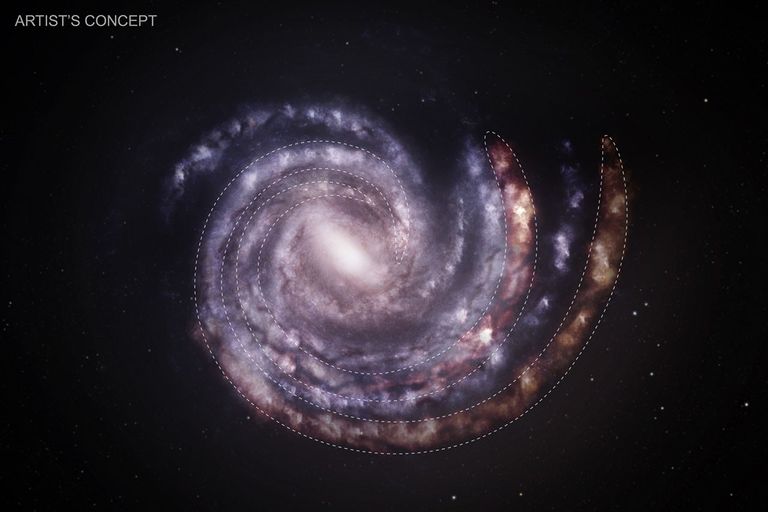
NASA’s new result suggests that two of the Milky Way’s outer spiral arms — the Outer Arm and the Outer Scutum-Centaurus Arm — may be about 10% farther from the galactic centre than previous estimates suggested.
That might not sound huge, but in galactic terms, 10% is not pocket change. When you are measuring a galaxy over 100,000 light-years wide, even a small correction can change the bigger picture.
The Clue Came From Gamma-Ray Bursts
The clever part is how astronomers measured it.
They used something called X-ray light echoes from gamma-ray bursts. Gamma-ray bursts are some of the brightest explosions in the universe, usually linked to events like the collapse of massive stars or the merger of neutron stars. They happen far beyond our galaxy, but their light can pass through the Milky Way on the way to us.
As that light travels through our galaxy, it can bounce off dust clouds inside the Milky Way’s spiral arms. When this happens, it creates ring-like patterns in X-rays. Chandra and XMM-Newton can detect those rings.
The size of the rings tells astronomers how far away the dust clouds are. Larger rings come from dust clouds closer to Earth, while smaller rings point to dust clouds farther away. It is geometry doing the heavy lifting, which is always nice because geometry does not care about anyone’s vibes.
This method allowed researchers to measure distances to dust clouds in the Milky Way’s spiral arms more directly than many older techniques.
Why Mapping the Milky Way Is So Hard
The Milky Way has been known to have spiral arms for roughly a century, but scientists are still working out their exact shape and position.
The problem is our location. Earth is not floating above the galaxy with a clean view. We are embedded inside it. Dust blocks visible light. Gas clouds overlap. Stars sit in front of other stars. Everything is moving. It is a cosmic traffic jam, except the traffic is made of plasma, dust, and ancient nuclear furnaces.
Many traditional methods for mapping the Milky Way depend on assumptions about how the galaxy rotates. But those assumptions become less reliable in the outer regions of the galaxy, where the structure is harder to trace.
That is why the new Chandra result matters. According to NASA, the X-ray echo method relies mainly on geometry, rather than assumptions about how the Milky Way rotates.
The Outer Arms May Be Farther Away
NASA/CXC/SAO/M.Weiss
Using three gamma-ray bursts, the team measured distances to three spiral arms: the Perseus Arm, the Outer Arm, and the Outer Scutum-Centaurus Arm.
The key result is that the two outermost arms appear to be farther from the centre of the Milky Way than previously thought. NASA says both the Outer Arm and the Outer Scutum-Centaurus Arm may be about 10% more distant than earlier estimates.
That means the outer structure of the Milky Way could be more spread out than astronomers had mapped before.
This does not mean the entire galaxy has suddenly doubled in size or that every space textbook needs to be thrown into a black hole. But it does mean that the galaxy’s outer shape may need adjusting.
And that matters because the structure of the Milky Way is tied to bigger questions: how much mass it contains, how its arms formed, how stars are distributed, and how our galaxy compares to other spiral galaxies.
A Galaxy We Still Do Not Fully Know
There is something humbling about this discovery.
The Milky Way is our home galaxy. Every star you see in the night sky belongs to it. Our Sun, Earth, Moon, and every planet in the Solar System are all moving through this huge spiral structure.
And yet, we are still refining the map.
NASA’s result is a reminder that astronomy is not only about looking at distant galaxies on the edge of the observable universe. Sometimes, the mystery is right around us. Not “around us” as in next door, obviously. More like “wrapped around the entire Solar System at galactic scale.” Minor detail.
Why This Discovery Matters
The Milky Way is not just a pretty band of light across the night sky. It is the structure that shaped the history of our Solar System. Understanding its arms helps scientists understand where stars form, how gas and dust move, and how galaxies evolve over billions of years.
If the outer arms are farther away than we thought, then astronomers may need to revise parts of the Milky Way’s structure. That could also affect estimates of the galaxy’s mass, because the width and shape of its arms are connected to how matter is distributed across the galaxy.
The discovery also shows how different space missions work together. Chandra detected the X-ray light echoes, while ESA’s XMM-Newton contributed data to the study. It is another example of how building a better picture of the universe often requires more than one telescope, more than one wavelength of light, and more than one clever team of scientists.