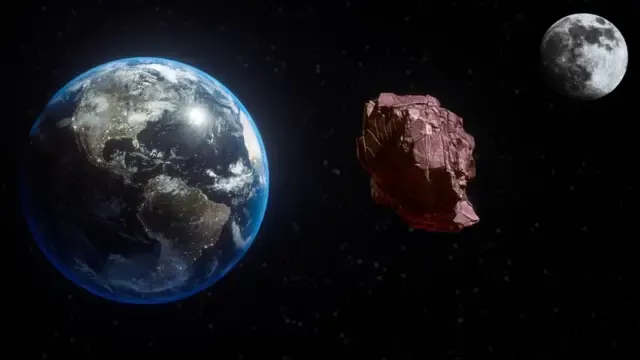

Earth has the Moon.
But it also has something much smaller, stranger, and far less famous travelling near it.
China’s Tianwen-2 spacecraft has returned the first close-up image of asteroid 2016 HO3, better known as Kamoʻoalewa — a small near-Earth asteroid often described as one of Earth’s quasi-moons. China’s National Space Administration reported that the spacecraft reached about 20 kilometres from the asteroid and began scientific observations after a journey of roughly 400 days and about 1 billion kilometres.
The image may not look spectacular at first glance. It shows a small, grey, irregular rock floating against black space. But scientifically, this is a big moment. Kamoʻoalewa is not just another asteroid. It follows Earth around the Sun in a strange orbital dance, staying near our planet for long periods without being a true moon. Even more interesting, some studies have suggested it may actually be a fragment of the Moon, blasted into space by an ancient impact.
So yes, that little rock may be a lost piece of our own Moon. Space, as usual, refuses to keep family drama simple.
What Is Kamoʻoalewa?
Kamoʻoalewa is a small near-Earth asteroid with the formal designation 469219 Kamoʻoalewa, originally known as 2016 HO3. It was first identified in 2016, and NASA’s Jet Propulsion Laboratory described it at the time as a stable quasi-satellite of Earth. That means it appears to loop around Earth from our point of view, but it is not gravitationally bound to Earth in the way the Moon is. Instead, it orbits the Sun in a path that stays close to Earth’s own orbit.
That distinction matters. A true moon orbits a planet. Kamoʻoalewa orbits the Sun.
Earth’s gravity influences its motion, making it appear like a companion, but it is not locked around Earth like the Moon. Calling it a “second moon” is catchy, but it is not really accurate. It is more like a cosmic tag-along.
NASA said in 2016 that 2016 HO3 had likely been a stable quasi-satellite of Earth for almost a century and would continue following this pattern for centuries to come. So it is not just passing by for a quick hello. It is hanging around. Quietly. Suspiciously.
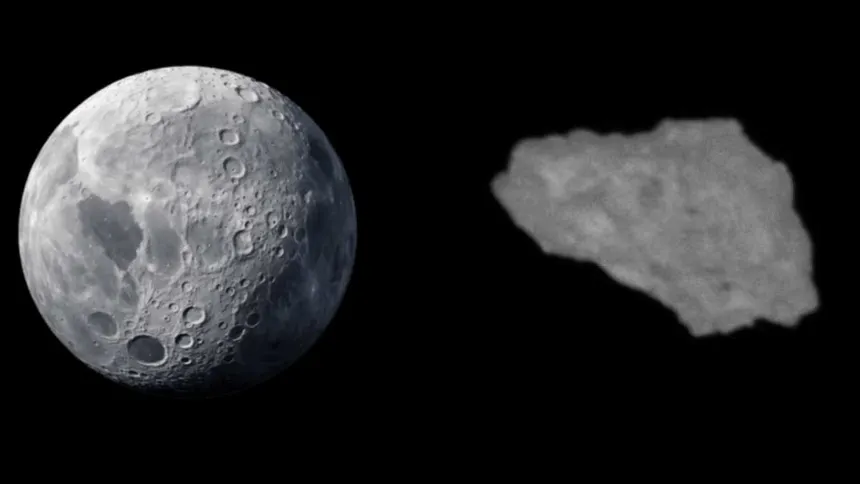
China’s Tianwen-2 Has Now Seen It Up Close
The new image comes from Tianwen-2, China’s first asteroid sample-return mission.
According to China’s National Space Administration, Tianwen-2 launched from the Xichang Satellite Launch Center on 29 May 2025. The spacecraft carried out deep-space manoeuvres and course corrections on its way to Kamoʻoalewa. It first detected the asteroid on 6 June 2026, performed a capture-control manoeuvre from around 30,000 kilometres away on 7 June, reached about 2,000 kilometres on 19 June, and later approached to around 20 kilometres, where it captured the newly released image.
That timeline matters because this was not just “point camera, take photo.” Finding and approaching such a small object in deep space is extremely difficult. The asteroid is tiny, distant, dim, and moving. Tianwen-2 had to use optical navigation to refine its position as it closed in. CNSA said the mission team used optical navigation data collected during the approach to improve the asteroid’s ephemeris, its predicted position, reducing the uncertainty from hundreds of kilometers to the kilometer scale.
That is deep-space precision. Or, in normal human terms: they found a small rock in the dark after flying for a billion kilometres. Not bad.
Why This Asteroid Is So Interesting
Kamoʻoalewa is scientifically valuable because it may not be a typical asteroid. A 2021 study published in Communications Earth & Environment found that Kamoʻoalewa’s reflected light looked unusually similar to lunar-like silicate material, raising the possibility that it may be made of material blasted off the Moon by an ancient impact.
That idea is still being investigated. It is not confirmed yet. But if Tianwen-2 returns samples from Kamoʻoalewa, scientists could directly test whether this asteroid really is a piece of the Moon. That would be huge.
It would mean a chunk of lunar material was knocked into space, escaped the Moon, and eventually settled into a strange companion orbit near Earth. It would also give scientists a new way to study lunar impact history, space weathering, and how small bodies move through the Earth-Moon system. Basically, this asteroid could be a tiny witness to a violent event on the Moon. Small rock. Big gossip.
What Tianwen-2 Will Do Next
Tianwen-2 is not just there to take pictures. The mission’s main goal is to study Kamoʻoalewa, collect samples, and return them to Earth. China’s State Council previously described Tianwen-2 as a robotic mission designed to retrieve material from near-Earth asteroid 2016 HO3 before continuing toward main-belt comet 311P for a later science mission.
CNSA says the spacecraft will now carry out more detailed scientific investigations of Kamoʻoalewa, including its shape, surface material, composition, and internal structure. These observations will support preparation for the sampling attempt. That part is crucial.
Before touching an asteroid, mission teams need to understand what kind of surface they are dealing with. Is it dusty? Rocky? Loose? Solid? Covered in boulders? Spinning awkwardly like a potato with anxiety?
Small asteroids can be surprisingly difficult to sample. They have weak gravity, irregular shapes, and unpredictable surface conditions. NASA’s OSIRIS-REx mission to Bennu showed how strange asteroid surfaces can be, with material behaving less like solid ground and more like loose rubble.
Tianwen-2 has to work out how to safely collect a sample from a tiny object that is barely large enough to call a world.
Why Sample Return Matters
Remote observations are useful, but nothing beats bringing material back to Earth. A spacecraft can carry instruments, but laboratories on Earth are far more powerful. Scientists can examine returned samples with equipment that cannot realistically be flown on a spacecraft. They can study mineral grains, isotopes, chemistry, and microscopic structures in extreme detail. That is why sample-return missions are so valuable.
Japan’s Hayabusa and Hayabusa2 missions returned samples from asteroids Itokawa and Ryugu. NASA’s OSIRIS-REx returned samples from Bennu. Tianwen-2 could add Kamoʻoalewa to that very exclusive list. If the asteroid really has a lunar origin, the returned material could help answer a fascinating question: Can pieces of the Moon become long-term near-Earth asteroids?
That sounds like a niche question, but it connects to a much bigger one: how material moves between worlds after impacts. The Solar System is not neat. It throws rocks around.
A Quasi-Moon Is Not a Mini-Moon
This is where the wording matters.
Some headlines call Kamoʻoalewa a mini-moon or Earth’s second moon, but that can be misleading. A mini-moon usually refers to a small object temporarily captured into orbit around Earth. A quasi-satellite is different. Kamoʻoalewa stays near Earth because its orbit around the Sun is similar to Earth’s, not because it is orbiting Earth as a true satellite.
NASA’s JPL described 2016 HO3 as Earth’s “constant companion,” but also made clear that it is a quasi-satellite, not another Moon. So the best way to describe it is:
Kamoʻoalewa is Earth’s quasi-moon — a small asteroid that orbits the Sun while staying close to Earth’s path.
Why This Discovery Matters
The first close-up image of Kamoʻoalewa is important because it marks the beginning of direct exploration of one of Earth’s most unusual companions. Until now, scientists studied this asteroid from Earth using telescopes. That gave them clues about its orbit, brightness, colour, and possible composition. But a spacecraft nearby can do much more.
Tianwen-2 can map the object’s shape, inspect its surface, study its composition, and prepare for sample collection. CNSA says the next phase will gather information about Kamoʻoalewa’s morphology, material composition, and internal structure.
That means this first image is not the ending. It is the opening shot.
Over the coming months, we should learn whether Kamoʻoalewa is a typical near-Earth asteroid, a strange weathered object, or something far more interesting: a lost fragment of the Moon.