A black hole is one of the strangest objects in the universe.
It is not a hole in space. It is not a cosmic vacuum cleaner flying around swallowing everything for fun. And despite what science fiction sometimes suggests, black holes are not magic portals waiting to politely send you to another galaxy.
A black hole is a region of space where gravity has become so strong that nothing can escape from it.
Not planets.
Not stars.
Not even light.
That last part is what makes black holes so famous. Light is the fastest thing in the universe, yet once it crosses the boundary of a black hole, it cannot get back out. That is why black holes appear black. They do not shine by themselves, because any light that gets too close is trapped.
But the black hole itself is not really an empty hole.
It is more like an enormous amount of mass crushed into an incredibly small space. Imagine taking something massive, like a star, and squeezing it down so tightly that its gravity becomes extreme. At some point, the object becomes so dense that escape becomes impossible.
That is a black hole.
Simple idea. Terrifying consequences.
-
China Releases First Close-Up Photo of Earth’s Strange Quasi-Moon
Earth has the Moon. But it also has something much smaller, stranger, and far less famous travelling near it. China’s Tianwen-2 spacecraft has returned the first close-up image of asteroid 2016 HO3, better known as Kamoʻoalewa — a small near-Earth asteroid often described as one of Earth’s quasi-moons. China’s National Space Administration reported that the…
-
NASA Webb Reveals a Galaxy Still Scarred by a Cosmic Collision
Some galaxies look peaceful from far away. Centaurus A is not one of them. NASA has released a new image from the James Webb Space Telescope, showing the nearby galaxy Centaurus A in extraordinary infrared detail. The image was published on 6 July 2026 to mark Webb’s fourth year of science operations, and it reveals…
-
Is the Speed of Dark A Real Thing?
Everyone knows about the speed of light. It is one of the most famous limits in the universe, clocking in at roughly 186,000 miles per second, or about 300,000 kilometers per second. NASA gives the exact speed of light in a vacuum as 299,792,458 meters per second. That number is not just fast. It is…
Is a Black Hole Really a Hole?
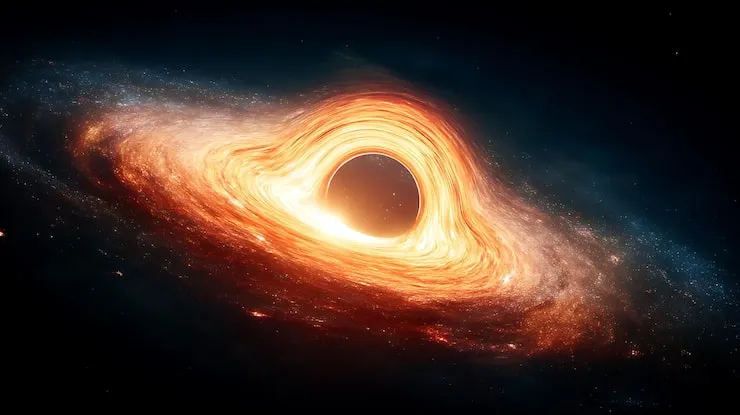
No. A black hole is not a hole in the same way a hole in the ground is a hole.
It is not an empty tunnel. It is not a cosmic drainpipe. It is not the universe forgetting to finish rendering a bit of space.
A black hole is a real physical object, or more accurately, a region of space shaped by extreme gravity. The name “black hole” comes from the fact that it is black because light cannot escape, and it behaves a bit like a hole because anything that falls in cannot climb back out.
The important thing to understand is this:
A black hole has mass.
That means it has gravity.
If you replaced the Sun with a black hole of the same mass, Earth would not instantly get sucked in. Earth would keep orbiting, because the gravity at Earth’s distance would be the same. We would freeze, obviously, because the Sun would no longer give us heat and light, which is a tiny drawback. But Earth would not suddenly spiral into doom like a badly animated disaster movie.
Black holes are only dangerously “sucky” if you get very close.
From far away, a black hole behaves like any other massive object. It pulls on things using gravity. The difference is what happens near the centre, where gravity becomes extreme beyond anything we experience on Earth.
What Is the Event Horizon?
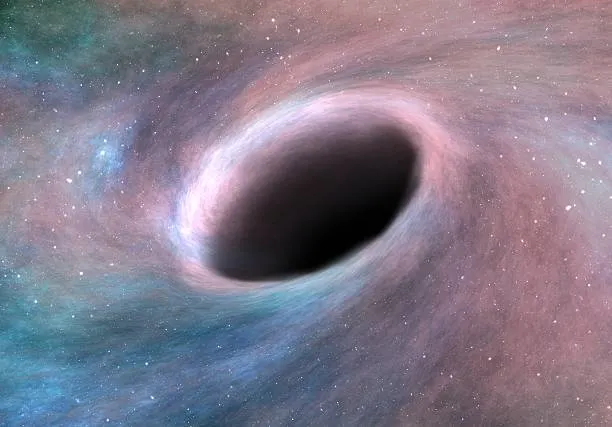
The event horizon is the boundary around a black hole where escape becomes impossible.
Think of it as the point of no return.
Outside the event horizon, escape is still possible if you have enough speed and the right direction. Inside the event horizon, every possible path leads deeper into the black hole. Once something crosses that boundary, there is no known way back.
This is not because the object gets stuck in a sticky surface. The event horizon is not a solid wall. You would not crash into it like a window.
It is a boundary in space.
Crossing it means the rules have changed. Space and time are warped so severely that moving forward in time means moving inward toward the centre.
That is one of the reasons black holes are so difficult to imagine. They are not just strong gravity objects. They are places where gravity changes the structure of space and time itself.
How Do Black Holes Form?
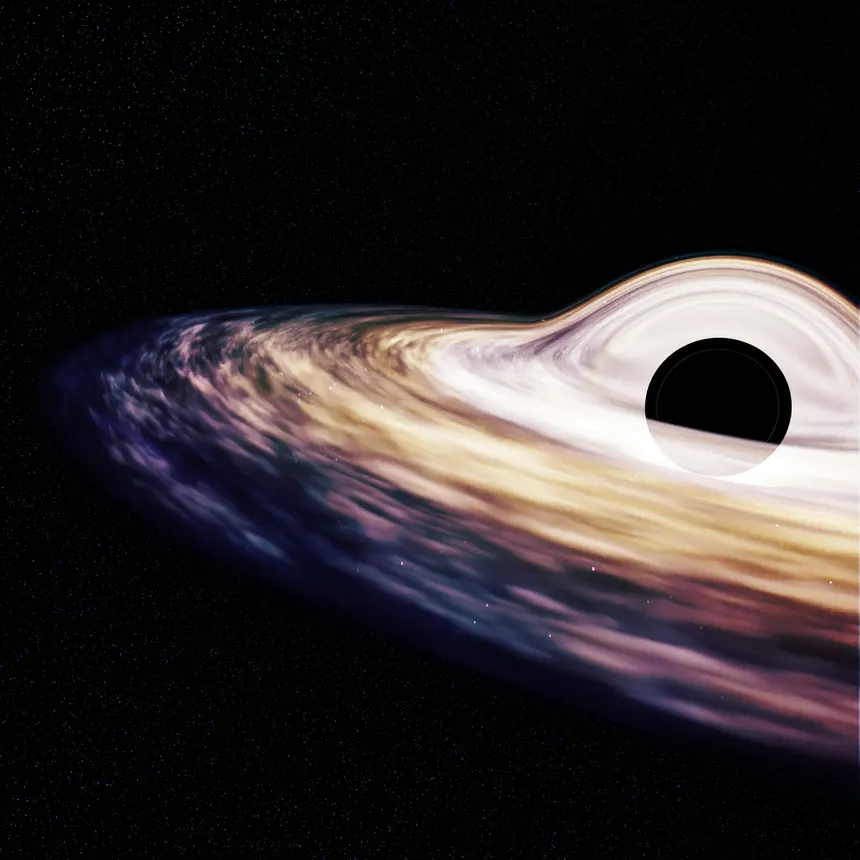
The most well known type of black hole forms when a massive star dies.
Stars spend most of their lives balancing two forces. Gravity pulls everything inward. Nuclear fusion in the core pushes outward by producing energy. As long as these forces are balanced, the star remains stable.
But massive stars eventually run out of usable fuel in their cores.
When that happens, the outward pressure weakens. Gravity wins. The core collapses inward, and the outer layers can explode in a supernova. What remains depends on how massive the original star was.
Some collapsed stars become neutron stars.
But if the remaining core is massive enough, gravity crushes it past the point where even a neutron star can survive.
A black hole is born.
There are also supermassive black holes, which can contain millions or even billions of times the mass of the Sun. These sit at the centres of many galaxies, including our own Milky Way. The one in the centre of our galaxy is called Sagittarius A star.
How supermassive black holes formed so early in the universe is still one of the big questions in astronomy. They may grow by feeding on gas, dust, stars, and by merging with other black holes when galaxies collide.
In other words, the small ones are terrifying.
The giant ones are cosmic landlords.
What Happens If You Fall Into a Black Hole?
This depends on the size of the black hole.
If you fell feet first toward a smaller black hole, the gravity pulling on your feet would be much stronger than the gravity pulling on your head. That difference in gravity is called a tidal force. It would stretch you vertically and squeeze you sideways.
Scientists call this spaghettification.
Yes, that is the actual term.
Space can be elegant, but occasionally it sounds like a pasta crime scene.
Near a stellar mass black hole, spaghettification could happen before you even cross the event horizon. You would be stretched apart long before you had time to complain about the travel experience.
With a supermassive black hole, things get stranger. Because the event horizon is much larger, the tidal forces at the boundary can be weaker. In theory, you might cross the event horizon without instantly noticing anything dramatic at that exact moment.
But do not relax.
Once inside, escape is still impossible. The centre lies in your future, and every path leads inward.
Are Black Holes Dangerous?
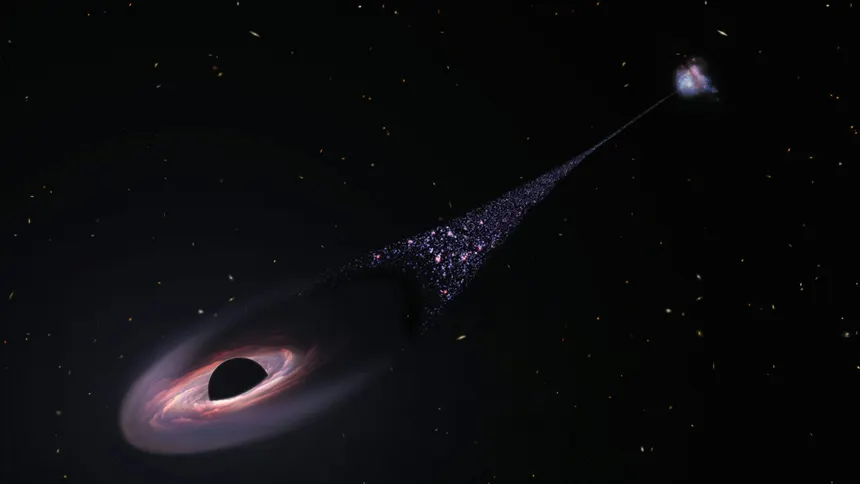
Black holes are dangerous if you are close to one. But they are not hunting us.
A black hole does not pull harder than another object of the same mass from far away. If a star collapses into a black hole without changing its mass, objects orbiting far away would continue to orbit in a similar way.
The danger comes from getting close enough that the gravity becomes extreme.
There are no known black holes close enough to threaten Earth. The supermassive black hole in the centre of the Milky Way is around 26,000 light years away. That is very far. It affects the structure of our galaxy, but it is not about to slurp up the Solar System like cosmic soup.
So no, Earth is not in immediate danger from a black hole.
You may continue worrying about normal human problems, like bills, WiFi, and why printers still behave like cursed Victorian machinery.
What Is Inside a Black Hole?
This is where science becomes genuinely mysterious.
According to general relativity, matter falling into a black hole may be crushed toward a point of infinite density called a singularity. At the singularity, our current equations stop working properly.
That does not necessarily mean nature has a real infinite point sitting there. It may mean our theories are incomplete.
Black holes sit at the boundary between general relativity, which describes gravity and space time, and quantum mechanics, which describes the behaviour of particles at tiny scales. We do not yet have a complete theory that joins these two worlds.
That is why black holes are so important.
They are not just weird objects.
They are clues.
They show us where our understanding of physics begins to crack.
Do Black Holes Last Forever?
Black holes may not last forever.
The physicist Stephen Hawking showed that black holes should slowly lose energy through a process now called Hawking radiation. Over unimaginable timescales, a black hole could eventually evaporate.
But for large black holes, this process is incredibly slow.
A black hole with the mass of a star would take far longer than the current age of the universe to evaporate. Supermassive black holes would last even longer.
So while black holes may not be eternal, they are playing the long game.
And by “long game,” we mean time spans so huge that human history looks like a notification you accidentally swiped away.
So, what is a black hole?
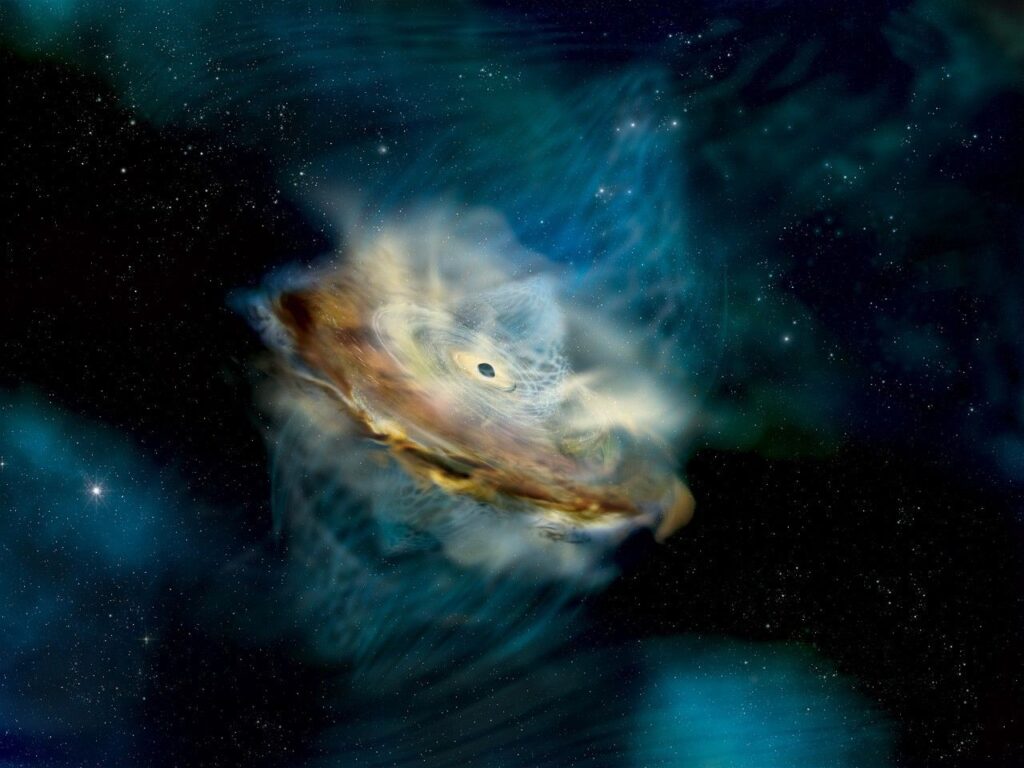
A black hole is a region of space where matter has been compressed so tightly that gravity becomes strong enough to trap everything, including light. The boundary around it is called the event horizon. Once something crosses that boundary, it cannot escape.
Black holes can form from the collapse of massive stars. Some grow into supermassive giants at the centres of galaxies. We cannot see black holes directly, but we can detect them by observing how they affect stars, gas, light, and space time around them.
They are not empty holes.
They are not cosmic vacuum cleaners.
They are not science fiction decorations.
They are some of the most extreme objects in the universe.
And the more we study them, the more they remind us of something uncomfortable:
The universe is not obligated to make sense to us.
We just happen to be clever enough to notice.
BLACK HOLES FAQ
What is a black hole in simple words?
A black hole is a place in space where gravity is so strong that nothing can escape, not even light.
Can a black hole swallow Earth?
There are no known black holes close enough to threaten Earth. Black holes are only dangerous if something gets very close to them.
Is a black hole really a hole?
No. A black hole is not an empty tunnel. It is a region of space where a huge amount of mass is packed into a very small area.
What is the event horizon?
The event horizon is the boundary around a black hole where escape becomes impossible.
Can we see black holes?
We cannot see the black hole itself, but we can see the glowing material around it and the effects it has on nearby stars and gas.