Space is full of stars.
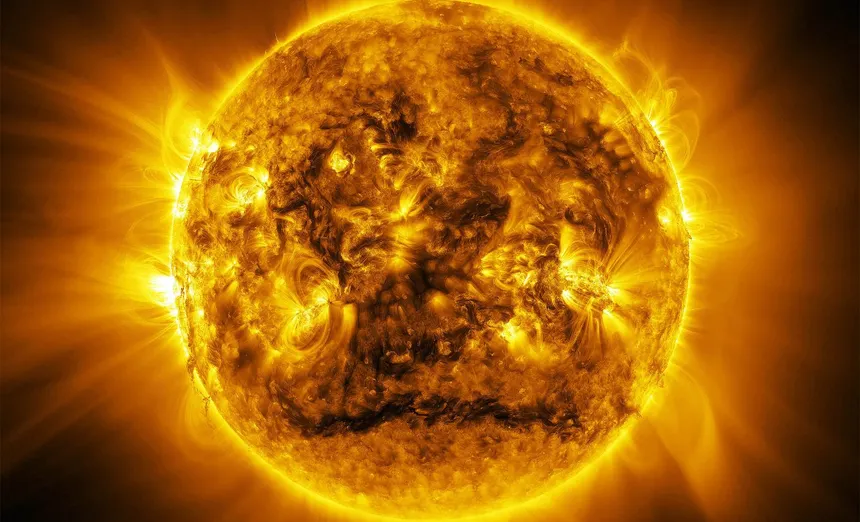
Our own Sun is so bright that you cannot safely look at it directly. It lights up Earth, warms the planet, powers weather, drives photosynthesis, and generally behaves like the Solar System’s aggressively glowing landlord.
So here is the obvious question.
If the Sun is so bright, and space is full of stars, why is space dark?
Why does the sky above Earth look blue during the day, but astronauts in orbit see black space even when the Sun is shining?
It feels like space should be glowing.
But it is not.
The simple answer is this:
Space is dark because there is almost nothing there to scatter light into your eyes.
That might sound too simple, but it explains one of the most common misunderstandings about space.

Why Is the Sky Blue on Earth?
To understand why space is dark, we first need to understand why Earth’s sky is not.
Earth has an atmosphere. That atmosphere is made of gases, tiny particles, water vapour, dust, and all the invisible stuff we normally forget about until weather decides to ruin the weekend.
When sunlight reaches Earth, it passes through the atmosphere. The light interacts with molecules in the air. Blue light gets scattered more easily than red light, so it spreads across the sky in every direction.
That is why, during the day, the sky looks blue.
You are not looking at blue space.
You are looking at sunlight being scattered by Earth’s atmosphere.
The atmosphere acts like a giant light diffuser wrapped around the planet. It takes sunlight coming from one direction and spreads some of it across the whole sky.
That is why the Sun can be in one part of the sky, but the rest of the sky still looks bright.
Why Is Space Black?
Space does not have an atmosphere like Earth.
There are particles in space, but compared with Earth’s atmosphere, space is almost empty. There is no thick blanket of air to scatter sunlight in every direction.
So when sunlight travels through space, it mostly just keeps going in a straight line.
Unless that light hits your eyes, a planet, a moon, dust, gas, or another object, you do not see it.
That is the key.
Light can pass right through the space around you, but if it is not travelling into your eyes, the space still looks black.
It is like standing in a dark room while someone shines a torch across the room from left to right. If the beam does not hit dust, smoke, a wall, or your eyes, you may barely see it. The light is there, but it is not being scattered toward you.
Space is the ultimate version of that.
The Sun can be shining, but the surrounding space can still look black because there is almost nothing there to light up.
Why Do Astronauts See Black Space During the Day?
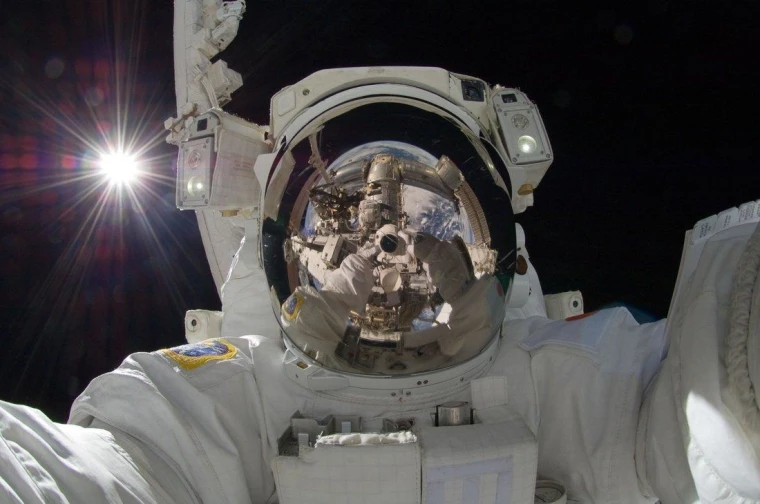
Astronauts in orbit can see the Sun, Earth, and the Moon shining brightly. But the space around those objects still appears black.
That is because orbit is above most of Earth’s atmosphere.
Without a thick atmosphere around them, sunlight does not scatter across the sky the way it does on Earth. The Sun is still extremely bright, but the background remains dark.
This is why photos from space often look strange to people.
You might see Earth glowing blue and white, lit by the Sun, while the space behind it looks completely black. That is not because the photo is fake. It is because Earth is reflecting sunlight, while empty space is not.
Objects are visible when light reaches them and then travels into your eyes or a camera.
Empty space has very little material to reflect or scatter that light.
So it stays dark.
Why Do Stars Not Light Up All of Space?
This is where the question gets even better.
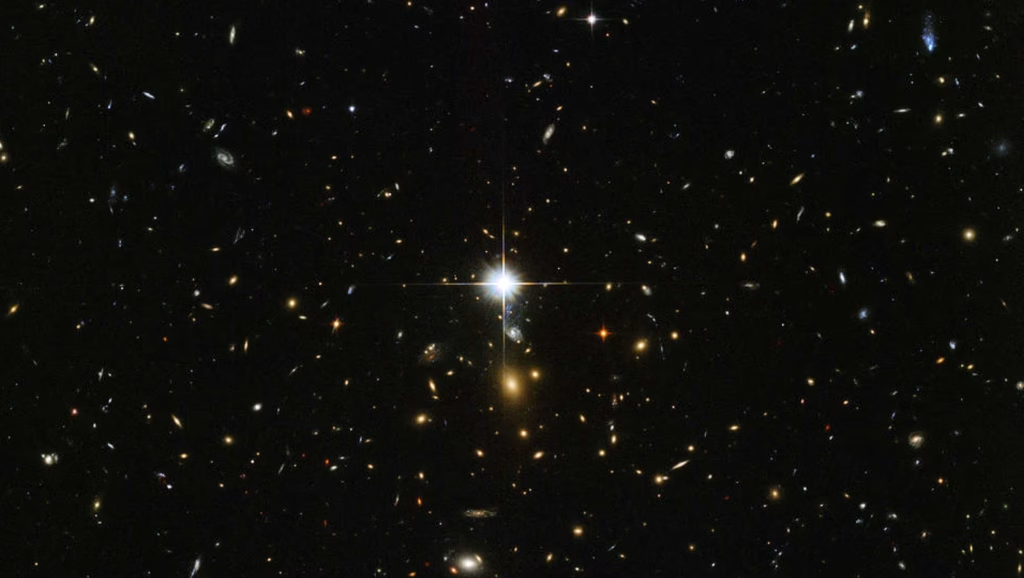
Space is full of stars, so why do they not fill the entire sky with light?
This question is connected to an old astronomy puzzle called Olbers’ paradox.
The basic idea is simple: if the universe were infinite, eternal, and filled evenly with stars, then every direction you looked should eventually end at a star. In that case, the night sky should be bright, not dark.
But the night sky is dark.
So what is going on?
There are a few important reasons.
First, the universe has a finite age. It is about 13.8 billion years old, which means light from extremely distant regions has not had unlimited time to reach us.
Second, the universe is expanding. Light from very distant galaxies gets stretched as space expands. This stretching shifts the light toward longer wavelengths, sometimes out of the visible range.
Third, stars and galaxies are not packed into every tiny patch of sky in a way that makes the whole universe glow visibly to human eyes.
So the darkness of space actually tells us something important.
It tells us the universe is not just an eternal static box full of stars. It has a history. It has changed over time. It is expanding.
The darkness is not empty nonsense.
It is evidence.
But Space Is Not Completely Dark
Here is the twist.
Space looks dark to human eyes, but it is not completely dark.
The universe is filled with different kinds of radiation and faint light. There is the cosmic microwave background, which is leftover radiation from the early universe. There is infrared light from dust. There are radio waves from galaxies. There are X rays from energetic objects like black holes and neutron stars.
Human eyes just cannot see most of it.
Your eyes are built for visible light. They are not radio antennas. They are not infrared detectors. They are not X ray observatories. Which is probably for the best, because seeing every wavelength at once would make reality look like someone spilled the entire universe into a broken television.
Telescopes can detect what we cannot.
That is why space images from observatories often reveal glowing gas, hidden stars, galaxy structures, and invisible radiation translated into colours we can understand.
So space is dark visually, but scientifically it is alive with signals.
The darkness is partly a limitation of human vision.
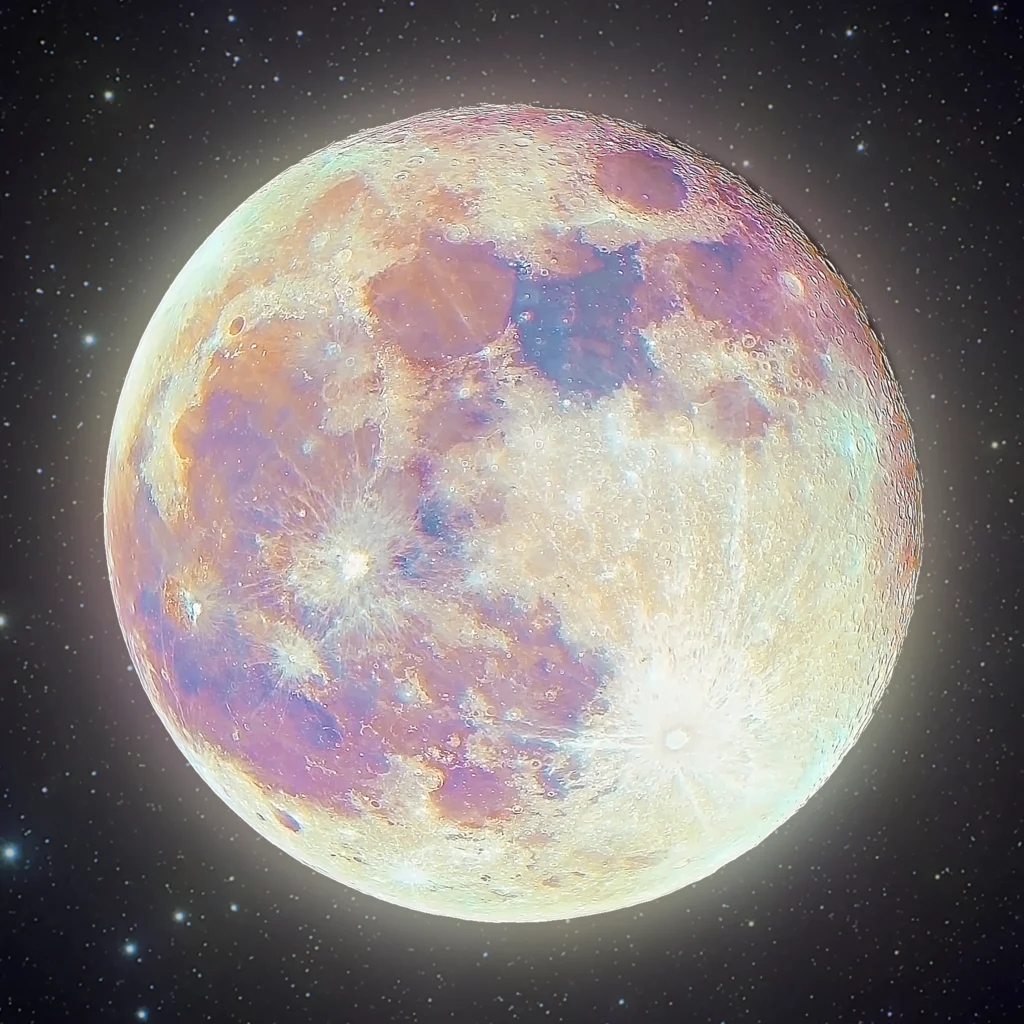
Why Does the Moon Shine in Dark Space?
The Moon does not produce its own light.
It shines because it reflects sunlight.
That is why we can see the Moon against the blackness of space. Sunlight hits the lunar surface, reflects back toward Earth, and reaches our eyes.
The same is true for planets.
Venus, Mars, Jupiter, and Saturn shine in our night sky because they reflect sunlight. They are not stars. They do not create their own visible light in the same way the Sun does.
This is also why spacecraft and satellites can be visible from Earth. They reflect sunlight while passing overhead.
So again, the rule is simple:
You see objects when light reaches them and then reaches you.
You do not see empty space because there is almost nothing there to send that light into your eyes.
Why Does Space Look Black in NASA Photos?
A lot of people see NASA images with black backgrounds and immediately ask where all the stars are.
This happens especially with Moon landing photos or images taken near bright objects.
The reason is usually camera exposure.
If a camera is set to photograph something bright, like the Moon’s surface, Earth, a spacecraft, or an astronaut in sunlight, faint stars may not appear. The camera is not exposing for tiny distant points of light. It is exposing for the bright subject in front of it.
This is the same reason you can take a night photo of a person under a bright streetlight and not capture many stars behind them.
The stars are still there.
The camera settings just are not designed to reveal them in that shot.
So black space in a photo is not suspicious by itself.
It is exactly what you should expect when photographing bright objects in an environment without atmospheric scattering.
Does The Sun Light Up Space?
Yes, the Sun lights up objects in space.
It lights up planets, moons, asteroids, comets, spacecraft, dust, and gas.
But it does not light up empty space in the same way it lights up Earth’s sky.
That is the difference.
On Earth, sunlight hits the atmosphere and scatters. In space, sunlight travels through near emptiness until it hits something.
So the Sun can be blazing in one direction while the space around it remains black.
This feels strange because we live inside an atmosphere. Our everyday experience tells us that sunlight makes the whole sky bright.
But space does not care about our everyday experience.
Space is not rude.
It is just extremely empty.

Frequently Asked Questions
Why is space dark but Earth’s sky is blue?
Earth’s sky is blue because sunlight is scattered by molecules in the atmosphere. Space has no thick atmosphere to scatter sunlight, so it appears black.
Is space completely dark?
No. Space contains many forms of radiation and faint light, including radio waves, infrared light, X rays, and the cosmic microwave background. Human eyes cannot see most of it.
Why does space look black in NASA photos?
Space looks black in many NASA photos because there is little material to scatter light, and cameras are often exposed for bright objects like Earth, the Moon, astronauts, or spacecraft.
Why are there no stars in some space photos?
Stars may not appear because they are too faint for the camera exposure used. If the camera is set for a bright subject, faint background stars can disappear from the image.
Does the Sun shine in space?
Yes. The Sun shines in space, but its light mostly travels in straight lines until it hits something. Without an atmosphere to scatter that light, the surrounding space still looks dark.
Why is the night sky dark if there are so many stars?
The night sky is dark partly because the universe has a finite age and is expanding. Light from extremely distant objects has not always reached us, and some distant light has been stretched beyond visible wavelengths.