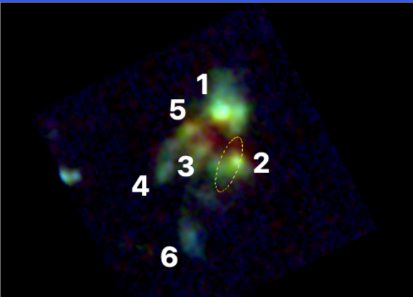

The James Webb Space Telescope has just caught something extraordinary in the early universe: at least six galaxies packed together and merging into what may become one of the largest galaxies in the cosmos.
At the center of this cosmic construction site, astronomers also found evidence of a growing supermassive black hole. The system is called TGSSJ1530+1049, which is not exactly a name that rolls off the tongue. It sounds more like a Wi-Fi password written by someone who hates humanity. But behind that ugly name is a beautiful discovery. Webb is not just seeing a galaxy. It is seeing a galaxy being built.
And because this system is more than 12 billion light-years away, the telescope is looking deep into the past, when the universe was still young. This means astronomers are watching a rare stage in cosmic history: the formation of a massive galaxy and the growth of its central black hole at the same time.
That is what makes this discovery so important.
Why Is This Discovery So Important?
This discovery matters because it shows how some of the largest galaxies in the universe may have formed.
Today, massive galaxies are often found at the centres of galaxy clusters. These huge elliptical galaxies did not appear from nowhere. They had to grow over time through collisions, mergers, gas inflows, star formation, and black hole activity. But catching that process while it is happening is difficult.
Most of the time, astronomers see either the finished product or scattered pieces of the story. Webb has now spotted something closer to the actual assembly phase. In TGSSJ1530+1049, several galaxies are still separate, but they are already close enough and massive enough that they are likely on the path to becoming one giant system. That gives astronomers a rare chance to study how massive galaxies grow in the early universe. It also helps answer a bigger question: How did the universe build giant galaxies so quickly?
How Far Away Is TGSSJ1530+1049?
TGSSJ1530+1049 is more than 12 billion light-years away. That does not just mean it is far away in space. It also means Webb is seeing it as it looked billions of years ago. Because light takes time to travel, looking far into space is also looking back in time. The light from this system has been travelling across the universe for more than 12 billion years before reaching our telescopes. So Webb is not seeing TGSSJ1530+1049 as it exists today, it is seeing the system when the universe was only around 1.5 to 1.8 billion years old.
That is young by cosmic standards. The universe today is about 13.8 billion years old, so this discovery lets scientists study a time when the first large structures were still being assembled. This is one of Webb’s greatest strengths. It can look through cosmic distance and show us parts of the universe that existed long before Earth, the Sun, or the Solar System formed.
A Growing Supermassive Black Hole
One of the most interesting parts of this discovery is the black hole at the center of the system. Astronomers believe that TGSSJ1530+1049 contains an active supermassive black hole. Radio observations show signs of material falling into the black hole, while some of that material is blasted outward in powerful jets. This matters because giant galaxies and supermassive black holes seem to grow together. In the modern universe, many large galaxies contain supermassive black holes at their centres. Even our own Milky Way has one: Sagittarius A*.
But scientists are still trying to understand exactly how these black holes became so massive, especially so early in cosmic history. Did the black hole grow first and influence the galaxy around it? Did the galaxy grow first and feed the black hole? Or did both grow together through the same violent process?
TGSSJ1530+1049 gives astronomers a chance to study both processes at once: galaxy growth and black hole growth happening inside the same ancient system. That is why this discovery is more than just a pretty image. It is a clue about how the universe built its biggest structures.
Why Webb Was Needed
The James Webb Space Telescope is designed to observe the universe in infrared light. That is crucial for studying very distant galaxies. As the universe expands, light from ancient galaxies gets stretched into longer wavelengths. This effect is called redshift. The farther away a galaxy is, the more its light is stretched. By the time light from the early universe reaches us, much of it has shifted into infrared wavelengths.
This is where Webb shines. Older telescopes could see parts of the story, especially through radio observations, but Webb can reveal the stars, gas, and structure hidden inside distant systems like TGSSJ1530+1049. In this case, Webb showed that what looked like a single target was actually a crowded galaxy complex. That is the power of JWST. It keeps turning “we found something interesting” into “actually, it’s worse, better, and far more complicated than we thought.” Classic universe behaviour.
What Is a Galaxy Merger?
A galaxy merger happens when two or more galaxies are pulled together by gravity and eventually combine. Despite how dramatic that sounds, individual stars usually do not crash into each other. Galaxies are mostly empty space. But gravity can seriously disturb gas, dust, stars, and black holes.
When galaxies merge, huge clouds of gas can be compressed, triggering intense bursts of star formation. Black holes at the centres of the galaxies may also grow as gas and matter fall inward. Over millions or billions of years, the separate galaxies can blend into one larger galaxy. Our own Milky Way is expected to merge with the Andromeda Galaxy in the distant future. That event will completely reshape both galaxies, although it will happen billions of years from now. So galaxy mergers are not rare in the universe. But seeing a massive merger in the early universe, involving several large galaxies and a growing black hole, is much more special.
TGSSJ1530+1049 is not just a collision. It is an early chapter in the formation of a giant galaxy.
Why the Early Universe Still Surprises Scientists
One of the biggest themes in modern astronomy is that the early universe seems to have grown complex structures very quickly. Webb has repeatedly found surprisingly mature galaxies, massive black holes, and structured systems at times when scientists expected the universe to be more primitive.
That does not mean the Big Bang model is broken every five minutes, despite what clickbait thumbnails love to scream. But it does mean astronomers are refining the details of how quickly galaxies and black holes formed. Discoveries like TGSSJ1530+1049 help scientists test models of cosmic evolution. They show whether our simulations of galaxy formation match what the universe actually did. And sometimes the universe looks at the simulation, laughs quietly, and adds six galaxies plus a black hole just to be annoying.