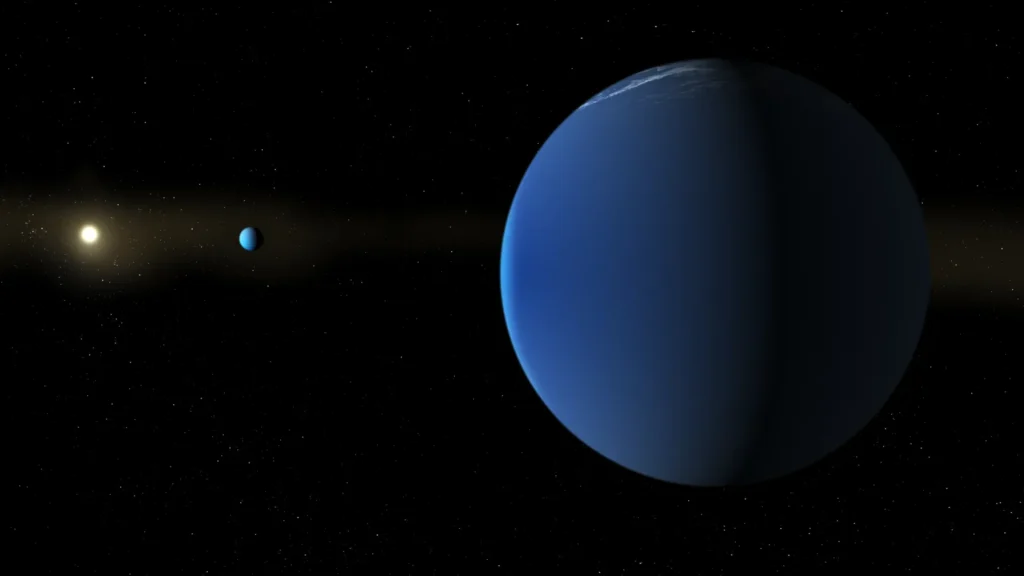

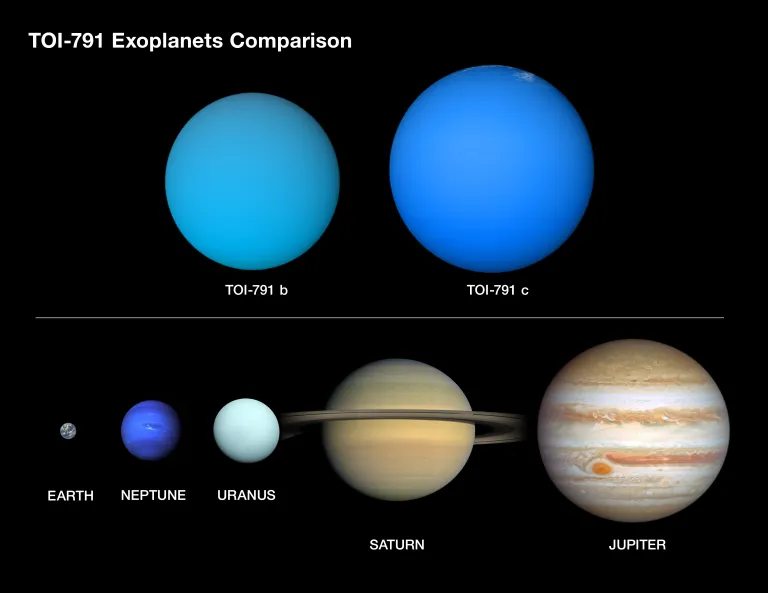
NASA’s TESS mission has discovered two of the puffiest planets ever found. The planets are called TOI-791 b and TOI-791 c, and they orbit a Sun-like star about 1,113 light-years from Earth. What makes them so strange is that they are roughly the size of Jupiter, but contain only a tiny fraction of Jupiter’s mass.
In simple terms, these planets are huge, but incredibly light. NASA describes them as “super-puff” planets, meaning their density is extremely low. TOI-791 b is nearly Jupiter-sized but has only about 3% of Jupiter’s mass. TOI-791 c is even larger than Jupiter but has only about 5.9% of Jupiter’s mass.
That makes them some of the lowest-density planets ever discovered. Basically, Jupiter-sized worlds with the cosmic firmness of candy floss. Space is ridiculous, and once again, completely serious.
What Are Super-Puff Planets?
Super-puff planets are exoplanets with unusually low density. They can be physically large, but their mass is surprisingly small. This means they must have very extended atmospheres or unusual internal structures that make them appear inflated. Scientists are interested in these planets because they are difficult to explain. Giant planets are usually expected to have much more mass. Finding Jupiter-sized planets this light challenges models of how planets form and evolve.
NASA’s TESS telescope discovered TOI-791 b and TOI-791 c by watching their star dim slightly as the planets passed in front of it. This is called the transit method. By studying the timing of those transits, scientists were able to measure the planets’ masses and confirm just how unusually puffy they are.
Why This Discovery Matters
These planets are important because they may help scientists understand how giant planets form.
Only a small number of super-puff planets are known, and finding two in the same system is especially rare. Their strange masses and sizes suggest they may have gone through an unusual formation or migration history.
TOI-791 b takes about 139 days to orbit its star, while TOI-791 c takes about 232 days. Those are relatively long orbits for planets detected this way, which makes the discovery even more valuable.
NASA says TESS gathered 1,122 days of data on the system across seven years. That long observation window helped scientists confirm the planets and study how they gravitationally tug on each other.
Could These Planets Support Life?
Probably not. These are giant, low-density planets, not rocky Earth-like worlds. They are more useful as laboratories for understanding planet formation than as possible homes for life.
But they still matter.
Every strange planet helps scientists understand how diverse planetary systems can be. Our Solar System has rocky planets, gas giants, ice giants, dwarf planets, moons, asteroids, and comets. But exoplanet systems keep showing us that nature has even more variety than expected. TOI-791 b and TOI-791 c are not just weird planets. They are clues. They may help explain how planets grow, migrate, lose atmosphere, or become inflated over time.