
A planet should not be there.
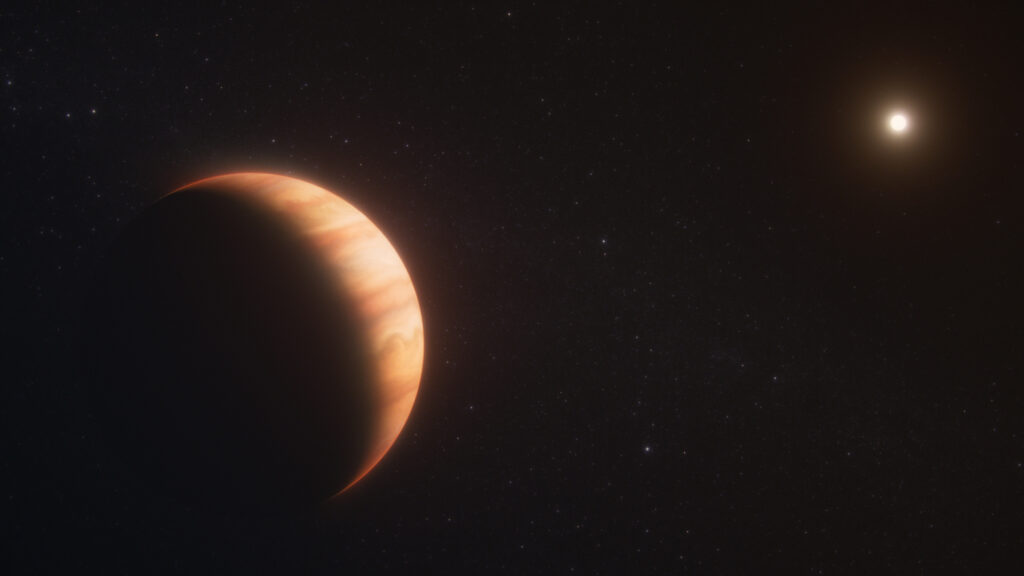
That is the awkward little problem astronomers are dealing with after NASA’s James Webb Space Telescope studied a strange world called WD 1856 b. It is a Jupiter-sized exoplanet orbiting a dead star — not gently, not from a safe distance, but incredibly close. The planet races around its star once every 34 hours, at a distance of less than 2 million miles. For comparison, that is roughly 50 times closer than Earth is to the Sun.
The problem is simple: the star it orbits is a white dwarf, the leftover core of a Sun-like star after it has died. Before becoming a white dwarf, that star would have expanded into a huge red giant, swelling so violently that nearby planets should have been swallowed or destroyed. Yet somehow, WD 1856 b is still there.
That makes this discovery more than just another weird exoplanet story. It gives astronomers a possible preview of what could happen to giant planets in our own Solar System billions of years from now.
A Giant Planet Orbiting a Dead Star
WD 1856 b was first discovered in 2020 using NASA’s TESS mission and the retired Spitzer Space Telescope. The system is located about 80 light-years from Earth, which is practically down the cosmic road compared with most exoplanet discoveries.
The planet itself is about the size of Jupiter, but the star it orbits is only about the size of Earth. That creates one of the strangest images in astronomy: a giant planet circling a tiny stellar corpse. NASA notes that the planet is around seven times larger than the star it passes in front of.
Webb observed the planet as it transited, meaning it crossed in front of its star from our point of view. This allowed astronomers to study how the star’s light changed as it passed through the planet’s atmosphere.
And that is where things got even more interesting.
Webb Detected Methane in Its Atmosphere
Using Webb, astronomers measured WD 1856 b’s temperature and detected signs of molecules in its atmosphere. The observations found evidence of methane, along with small cloud particles and hydrocarbons. According to NASA, this is the first time astronomers have seen an atmosphere on a planet transiting a dead star.
That matters because studying an atmosphere around a planet like this is not just about collecting a chemical shopping list. It tells scientists about the planet’s history. Atmospheres hold clues. They are basically cosmic receipts, except instead of proving you bought crisps at Tesco, they can reveal how a planet was heated, moved, and battered by gravity.
Webb also found that the planet is hotter than expected. Its temperature is around 260°F, or 126°C. That is too warm to be explained only by the weak light from the white dwarf.
So where did the heat come from?
The Planet Probably Moved After the Star Died
There were two main ideas. Either the planet somehow survived being swallowed during the star’s red giant phase, or it originally stayed far away and moved inward later.
Webb’s temperature measurement gave scientists the key clue. The planet appears to still be cooling from an earlier heating event. By modelling how that heat would fade over time, researchers concluded that WD 1856 b most likely moved inward after the star had already become a white dwarf.
In other words, the planet probably survived because it was not originally sitting that close to the star. It may have started farther out, safe from the star’s violent death, before gravitational interactions pulled it into its current tight orbit.
NASA says the white dwarf is part of a triple star system, meaning companion stars could have helped disturb the planet’s orbit and push it inward over time.
So the planet did not just survive the death of its star by casually tanking the explosion like a boss. More likely, it avoided the worst of the chaos, then migrated inward afterwards. Still impressive. Still rude to physics.
A Glimpse of Our Solar System’s Future
The reason this story hits harder is that our Sun is heading toward a similar fate.
In roughly five billion years, the Sun will run out of hydrogen fuel in its core and expand into a red giant. NASA says it will swell to more than 100 times its current size, likely destroying Mercury, Venus, and possibly Earth. After shedding its outer layers, it will leave behind a white dwarf.
The fate of the outer planets — Jupiter, Saturn, Uranus, and Neptune — is still less certain. That is why WD 1856 b is so valuable. It shows that giant planets can survive around the remnants of Sun-like stars, even if their final orbits look nothing like where they started.
This does not mean Jupiter will definitely end up whipping around the dead Sun every 34 hours. But it does show that planetary systems do not simply freeze in place after their stars die. They can keep changing for billions of years.
Why This Discovery Matters
WD 1856 b is not just “a planet around a dead star.” It is a fossil record of survival, migration, and stellar death.
Webb’s observations give astronomers a rare chance to study what happens after the main story of a star is over. Normally, we think of planets forming around young stars, orbiting mature stars, and then getting ruined when the star dies. But this system suggests the aftermath can be much more complicated.
Planets can survive. Orbits can change. Atmospheres can remain detectable. And in some cases, a giant world can end up orbiting a dead star so closely that one year lasts less than two Earth days.
The universe, as usual, refuses to behave neatly. Very inconsiderate of it.